A therapist running weekly video sessions on a personal Zoom account just found out that account was never under a Business Associate Agreement. It’s that one gap that makes a lot of practices start comparing doxy.me vs Zoom for healthcare before they put another patient on the schedule.
Doxy.me is purpose-built for telehealth, and offers a free HIPAA-eligible plan, and paid plans starting at $35-$50 per provider per month. Zoom for Healthcare takes a different approach: it’s the day-to-day video platform from Zoom with a signed BAA and healthcare-specific settings added on top, beginning with Pro plans and moving up to Business and Enterprise tiers. It is dependent on whether a practice wants a dedicated tool or one platform to do it all.
Buyers researching this pairing on forums often have the same question: If their clinic already pays for Zoom internally, is it worth adding a separate telehealth tool? Or does flipping on the healthcare BAA cover everything they need? The answer has more to do with workflow and compliance risk tolerance, and less to do with video quality.
Major Differences Between Doxy.me and Zoom for Healthcare
Doxy.me is here to do one thing: patient video visits. There’s no meeting software to install, no internal chat system to secure, and patients join through a simple browser link, no download required. Zoom for Healthcare, in contrast, is the same Zoom people use for staff meetings, sales calls, and webinars, with a healthcare BAA and configurable settings layered on.
Zoom is no longer a video meeting tool with a healthcare edition bolted on the side. In 2026, Zoom is marketing its healthcare offering as a broader collaboration platform across telehealth, phone, chat, scheduling and contact-center workflows. That breadth is appealing to practices already running Zoom Phone or Zoom Team Chat internally.
Doxy.me gets around all of that. It’s touted as HIPAA-eligible video conferencing built specifically for telehealth, and is commonly used by home care agencies for telehealth visits, family check-ins and HIPAA-tier video calls.
Where Zoom for Healthcare Excels
Practices already paying for Zoom licenses across the organization have a real advantage: one login, one admin console, one vendor relationship for meetings, phone and telehealth visits. Zoom is a good fit when it is already adopted by the organization, when video visits should be integrated with wider collaboration or phone workflows, when a BAA is needed, when EHR integration is important, or when the company expects to support larger provider or staff teams.
How Doxy.me Stands Out
Doxy.me is simple and many solo providers and small practices that just need a compliant video link for their patients prefer the simplicity of it. Reviewers often mention the free plan as sufficient for solo practices, but it does have limitations like no screen sharing, group sessions, passwords or higher video quality. An upgrade lifts those caps, without requiring an IT team to manage settings across an entire collaboration suite.
Is Zoom HIPAA Compliant for Healthcare?
This is the question that stumps most practices moving from personal Zoom accounts to a compliant setup.” If you have a qualifying paid plan and have requested to have a Business Associate Agreement (BAA) signed by Zoom, then Zoom is HIPAA compliant. You will also need to turn on HIPAA mode. Zoom will sign a Business Associate Agreement (BAA) with healthcare customers who have a qualifying paid plan which includes Zoom Workplace for Healthcare and Zoom accounts that meet the criteria for Business, Business Plus and Enterprise.
The BAA is never an automatic thing. It’s not automatic, practices have to ask for it through zoom’s healthcare compliance process and turn on the HIPAA settings on the account. Free and personal paid accounts without the healthcare add-on are not included at all. Free and standard personal accounts are never covered, so one patient call on one would be a violation.
Also worth repeating: there is no such thing as a HIPAA certification for software, though you may hear vendor marketing to the contrary. There is no government-issued HIPAA certification for software products and Zoom’s own security FAQ states there is no regulatory-backed HIPAA certification and the company supports customers’ HIPAA programs through its controls, contractual BAA and security architecture. Doxy.me works the same way, signing BAAs rather than holding a certification.
How Much Does Doxy.me vs Zoom for Healthcare Cost in 2026
Pricing is where the two tools genuinely diverge. Doxy.me publishes flat per-provider pricing, while Zoom’s healthcare-eligible pricing depends on which underlying plan a practice already holds.
| Plan | Doxy.me | Zoom for Healthcare |
|---|---|---|
| Free / Entry | Free, HIPAA-eligible with BAA | Not available, free Zoom excluded from BAA |
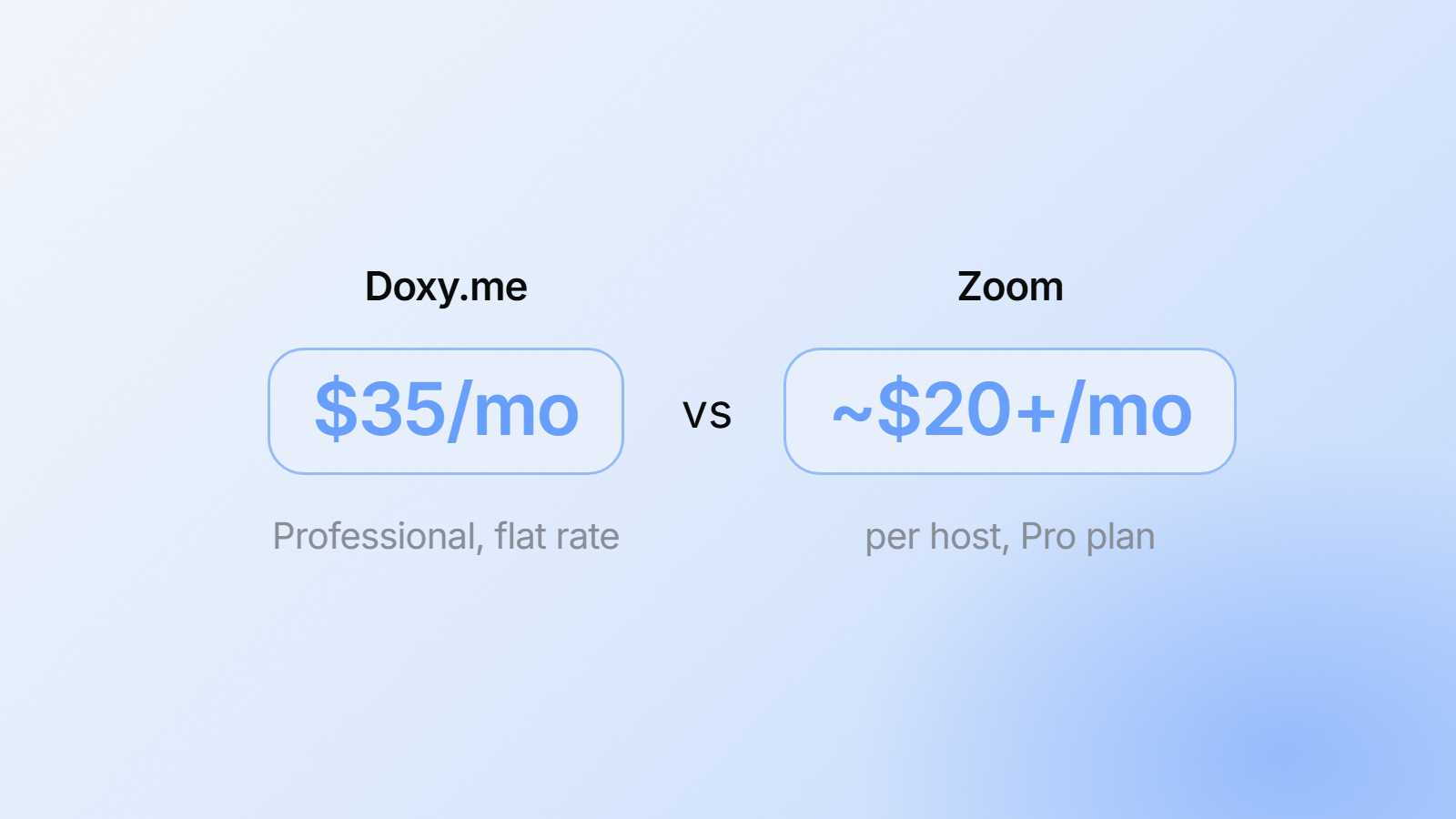
| Individual provider | $35/month flat rate (Professional) | ~$20+/host/month on eligible Pro plan |
| Clinic / Team | $50/provider/month (Clinic) | Business/Business Plus, sales-quoted |
| Enterprise | Custom pricing | Enterprise, sales-quoted with EHR integrations |
Source: Capterra, 2026; Carezano, 2026.
Doxy.me has 4 different plans, with pricing starting at $35 flat rate per month and a free plan available. On the Zoom side, the Healthcare plan runs roughly $20 or more per host monthly, with volume and annual pricing varying, though Business and Enterprise tiers needed for full BAA support and admin controls cost considerably more.
Doxy.me Alternative Options If Neither Fits
Some practices are between the two tools. If scheduling, intake forms and billing need to be in the same system as the video visit, a platform built around a complete practice workflow, not just video, tends to work better. That is a different conversation than this comparison, but worth flagging before committing budget to either doxy.me or Zoom for Healthcare based on video quality alone.
FAQs
Is Zoom for Healthcare HIPAA-compliant?
You can use Zoom in a HIPAA compliant way but only if you have one of the eligible paid plans (Pro, Business, Business Plus, or Enterprise), you have a signed Business Associate Agreement which you request through Zoom and you have HIPAA mode enabled in your account settings. Free and basic Zoom accounts are never covered and should not be used for any session involving patient health information.
What’s the difference between doxy.me and Zoom for Healthcare?
Doxy.me is telehealth-only, with a virtual waiting room, no patient downloads, and a free tier that is HIPAA-eligible. Zoom for Healthcare is generic video conferencing software with a healthcare BAA bolted on, with deeper integrations with phone, chat and calendar systems but more setup required to stay compliant.
Doxy.me or Zoom for Healthcare – which is cheaper?
Doxy.me has a free plan, it’s free and still meets HIPAA requirements with a BAA. The Professional tier is $35 per provider per month. Zoom’s healthcare-eligible plans are ~$20+ per host/month, but can escalate quickly with Business or Enterprise tiers needed for full administrative controls and BAA support.
Can I use my current Zoom account for telehealth visits?
Only if it’s a paid plan that’s eligible with signed BAA and HIPAA mode enabled. Unless you have a Personal Pro account without the healthcare add-on, or a free Basic account, you are not legally allowed to carry protected health information, even if the video quality feels the same as a compliant account.
Is doxy.me integrated with EHR systems?
Doxy.me’s core strength is simplicity, not deep EHR integration, and most practices use it as a standalone video layer on top of their existing records system. This broader healthcare plan, which is more relevant for larger organizations than for solo providers, is more directly marketed by Zoom for Healthcare as part of its EHR integrations.