Small business owners comparing NetSuite vs SAP Business One usually hit the same wall: one platform has a cleaner path to multi-entity growth, the other tends to cost less out of the gate and goes deeper on manufacturing. Picking wrong means either overpaying for capability you will not use for years, or outgrowing your system before the implementation invoice is even paid off.
Both are cloud-capable ERP platforms built by companies with decades of enterprise software experience: Oracle owns NetSuite, and SAP owns Business One. But their pricing models, deployment options, and target customer profiles diverge enough that the “better” choice depends heavily on your headcount, industry, and growth plans.
Here is the short version. NetSuite starts near $999 a month plus $99 to $199 per user, while SAP Business One runs $95 to $250 per user per month on cloud with no mandatory base fee. SAP Business One usually costs less for 5 to 25 users and implements faster; NetSuite scales better once you add subsidiaries or complex multi-entity accounting.
This guide breaks down real 2026 pricing, implementation timelines, manufacturing depth, and review scores from G2 and Capterra, so you can walk into vendor calls asking the right questions instead of guessing.
NetSuite vs SAP Business One: Quick Comparison Table
Before getting into the weeds, here is how the two platforms stack up across the factors small business buyers ask about most.
| Factor | NetSuite | SAP Business One |
|---|---|---|
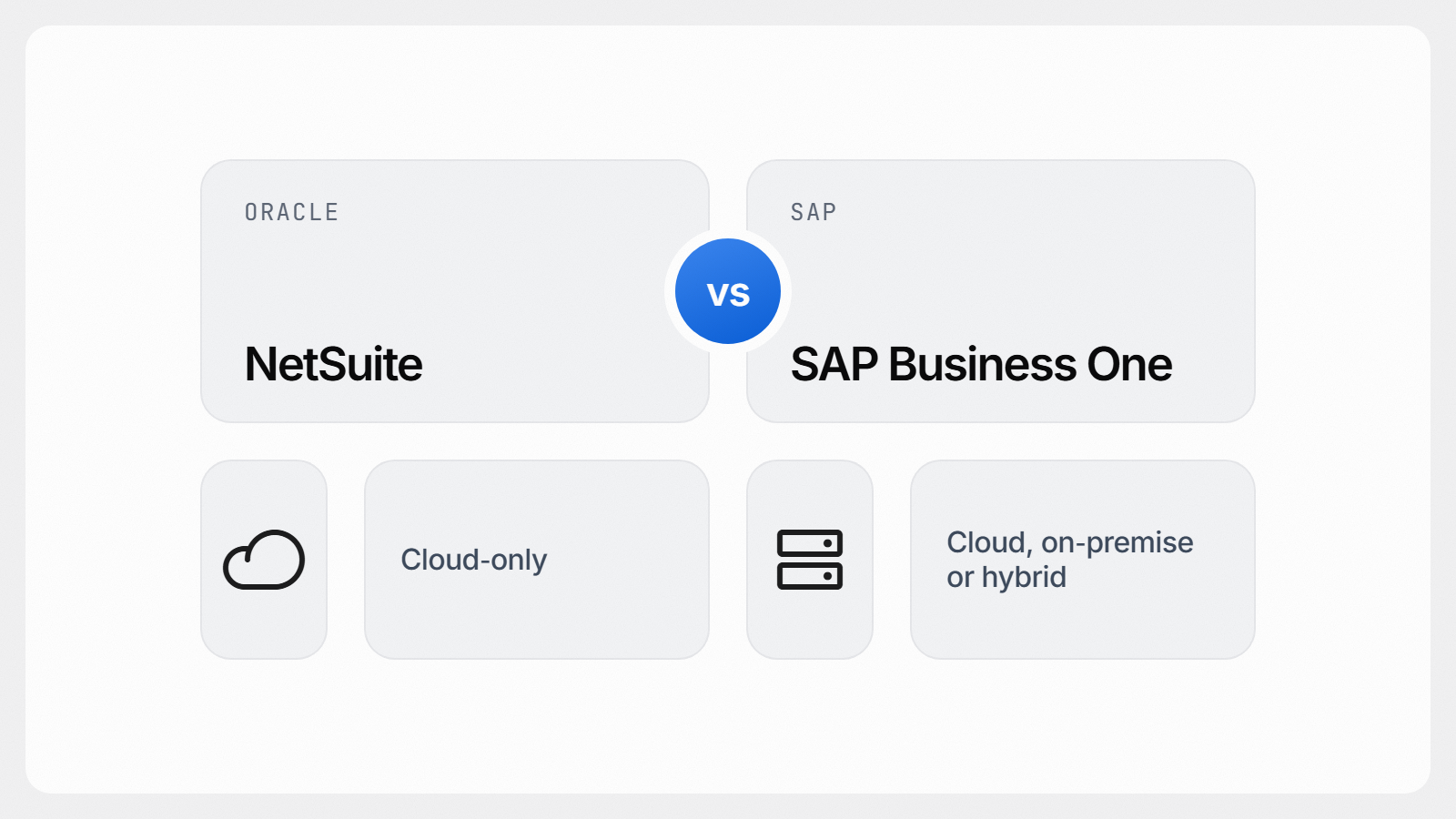
| Deployment | Cloud-only (SaaS) | Cloud, on-premise, or hybrid |
| Starting license cost | $999/month base + $99 to $199 per user/month | $95 to $250 per user/month (cloud); $3,500 to $5,500/user one-time (on-premise) |
| Typical small business implementation | $25,000 to $100,000 | $15,000 to $150,000 |
| Implementation timeline (SMB) | 8 to 12 weeks | 3 to 5 months |
| Multi-entity consolidation | Native (OneWorld) | Requires Intercompany Integration add-on |
| Manufacturing depth | Good, often needs Advanced Manufacturing SuiteApp | Native MRP, BOM, and production orders |
| G2 rating | 4.1/5 (4,514 reviews) | 4.3/5 (531 reviews) |
Source: ERP Research and G2, 2026.
How Much Does NetSuite Cost a Small Business in 2026
NetSuite’s pricing has three moving parts: a base platform fee, per-user licenses, and add-on modules.
Base license
NetSuite’s base license starts at $999 a month and covers core financials. User licenses run roughly $99 to $199 per user per month depending on license type, and add-on modules like CRM, WMS, or SuiteCommerce are priced separately.
Implementation
Published third-party estimates commonly place a small, single-entity NetSuite implementation in the $25,000 to $100,000 range, on top of the ongoing subscription. For a lean 5 to 10 user deployment with standard modules, that typically lands between $24,000 and $54,000 a year in license fees alone.
A realistic first-year total for a 5 to 10 user small business, including implementation, often falls in the $50,000 to $120,000 range once setup, data migration, and training are factored in.
How Much Does SAP Business One Cost a Small Business in 2026
SAP Business One prices by named user and license tier rather than a flat base fee.
License tiers
SAP Business One costs $95 to $250 per user per month on a cloud subscription, or $3,500 to $5,500 per user as a one-time on-premise perpetual license plus 18 to 20 percent annual maintenance. Professional users with full module access sit at the top of that range, while Limited and Starter licenses cost less for sales or basic-access roles.
Implementation
Implementation for SAP Business One typically runs $15,000 to $150,000 depending on complexity. A representative 25-user cloud deployment can run roughly $175,000 over three years when subscription and a mid-range implementation are combined.
For a 10-user team over three years, cloud subscription costs have been benchmarked at roughly $47,700 total, compared with about $33,442 for the perpetual on-premise licensing model over the same period, before implementation.
Which Costs Less for a 10-Person Team
At the 5 to 10 user mark, SAP Business One’s lack of a mandatory base platform fee usually makes it the lower-cost option. NetSuite’s $999 base fee is fixed regardless of headcount, so very small teams pay a proportionally higher rate per user until they scale past roughly 15 to 20 seats.
Which ERP Is Easier to Implement: NetSuite or SAP Business One
Implementation speed depends on your data, your partner, and how closely you stick to standard configuration, but the platforms do have different default paths.
Small businesses using NetSuite’s SuiteSuccess methodology typically move through implementation in 8 to 12 weeks, with preconfigured industry workflows designed to shorten go-live for smaller teams. Training at that size usually runs 20 to 40 total hours across the company.
A standard SAP Business One implementation for a mid-sized firm typically takes 3 to 5 months, assuming a relatively standard scope without heavy customization. Complexity rises quickly if you add multi-entity consolidation or manufacturing configuration on either platform.
One more practical difference: NetSuite requires far less internal IT support after go-live because it is cloud-only, while SAP Business One almost always needs IT resources to maintain, particularly for on-premise deployments.
Which ERP Scales Better as a Small Business Grows
- This is where the two platforms separate the most clearly for buyers planning to add locations, subsidiaries, or international entities.
- NetSuite OneWorld handles multi-subsidiary consolidation, intercompany elimination, and multi-currency translation natively inside one database. There is no end-of-period aggregation step required; a CFO can view consolidated financials in real time while a controller reviews an entity-level trial balance at the same moment.
- SAP Business One, by contrast, needs a separate Intercompany Integration add-on to handle multi-entity structures, and that add-on syncs data between separate company databases on a schedule rather than in real time. Buyers managing three or more legal entities generally find NetSuite the more direct answer, since SAP B1’s intercompany tooling tends to struggle past five or six entities.
- If your five-year plan involves staying a single legal entity with stable operations, this gap matters less. If you expect to add subsidiaries, open in new countries, or need real-time consolidated reporting, it matters a great deal.
NetSuite vs SAP Business One for Manufacturing Businesses
Manufacturing is the other area where buyer feedback consistently points in one direction.
SAP Business One’s production planning tools include multi-level bills of materials, work order management, material requirements planning, demand forecasting, and production scheduling, all built into the core product rather than sold as a separate module.
NetSuite covers multi-level BOMs with revision control and MRP with net-change and regenerative runs, but deeper shop-floor execution, finite capacity scheduling, and quality management typically require the Advanced Manufacturing SuiteApp, which adds configuration time and cost.
For a discrete manufacturer with complex routings and engineering changes, SAP Business One’s native depth is usually the more defensible starting point. For a services, SaaS, or multi-entity distribution business where manufacturing is secondary, NetSuite’s broader financial consolidation tools often outweigh the manufacturing gap.
User Ratings: What G2 and Capterra Reviewers Say
Independent review data gives a useful sanity check against vendor claims.
| Platform | G2 rating | Capterra rating | Capterra customer service score |
|---|---|---|---|
| NetSuite | 4.1/5 (4,514 reviews) | 4.2/5 (2,035 reviews) | 3.8/5 |
| SAP Business One | 4.3/5 (531 reviews) | 4.3/5 (344 reviews) | 4.0/5 |
Source: G2 and Capterra, 2026.
On Capterra, NetSuite reviewers most often cite business scalability and process workflow as strengths, with customization and team implementation showing up as pain points. SAP Business One reviewers highlight inventory management and data management, while flagging user interface and implementation process as areas to watch.
Reddit and small business forum threads echo this pattern in less formal terms: buyers moving from QuickBooks or Xero often describe NetSuite’s learning curve as steep for finance staff, while SAP Business One users more frequently mention needing a local VAR for ongoing support, especially on upgrades.
Frequently Asked Questions
Which is cheaper, NetSuite or SAP Business One?
For a small team of 5 to 10 users, SAP Business One is usually cheaper because it has no mandatory base platform fee, with cloud licenses running $95 to $250 per user per month. NetSuite adds a $999 a month base license on top of $99 to $199 per user, pushing small-business license costs to roughly $1,500 to $3,000 a month before implementation.
Is NetSuite easier to implement than SAP Business One?
Not necessarily faster, but often more structured. NetSuite’s SuiteSuccess methodology gets small businesses live in about 8 to 12 weeks, while a standard SAP Business One rollout typically takes 3 to 5 months. Actual speed depends more on data migration complexity and your implementation partner than on the platform itself.
Which ERP is better for manufacturing, NetSuite or SAP Business One?
SAP Business One is generally the stronger fit for manufacturers because its multi-level bill of materials, MRP, and production-order tools are native to the core product. NetSuite covers discrete manufacturing but often needs the Advanced Manufacturing SuiteApp for shop-floor execution and process manufacturing, adding cost and configuration time.
Can SAP Business One handle multiple subsidiaries like NetSuite OneWorld?
Only with help. NetSuite OneWorld handles intercompany eliminations, multi-currency translation, and consolidated reporting natively inside one database. SAP Business One needs a separate Intercompany Integration add-on that syncs data between databases on a schedule rather than in real time, and it tends to struggle once a company passes five or six legal entities.
Which ERP gets better customer support ratings from small business users?
SAP Business One edges out NetSuite on customer service in buyer review data. On Capterra, SAP Business One scores 4.0 out of 5 for customer service versus NetSuite’s 3.8, a gap users often attribute to the smaller, more localized network of SAP B1 resellers handling support directly.
Choosing Between NetSuite and SAP Business One in 2026
If you run a single-entity small business with straightforward operations and a manufacturing-heavy model, SAP Business One’s lower entry cost and native production planning tools make it the more budget-friendly starting point. If you expect to add subsidiaries, operate across currencies, or need real-time consolidated financials within three to five years, NetSuite’s OneWorld architecture saves you a painful re-implementation down the road.
Either way, get a scoped quote based on your actual user count and modules before committing, since list prices rarely match what you will pay after negotiation. You can compare detailed vendor profiles for NetSuite and SAP Business One side by side, review additional options on the ERP software hub, or request a tailored shortlist from a Software Finder advisor before you sign a contract.