In recent years Oracle, Microsoft, SAP and Sage have all reworked their flagship ERP products with an eye toward cloud delivery and most buyers researching the term get a sales pitch before they get a plain definition.
Cloud ERP is enterprise resource planning software delivered over the internet and hosted on a vendor’s remote servers (rather than on machines in your building) on a subscription basis. The Cloud ERP Market is valued at USD 113.94B in 2026 and is projected to reach USD 202.26B by 2030 at a CAGR of 15.4% (USD 113.94B in 2026) – a fair signal of how fast companies are moving away from in-house servers.
That growth isn’t just enterprise software companies chasing a fad. The cloud segment had the largest market share in 2025, accounting for 54.4% of the total ERP software market. This means that over 50% of every dollar spent on ERP today goes to cloud-hosted systems versus on-premise installations.
This guide explains what cloud ERP really is, how the architecture works behind the scenes, where it differs from on-premise systems in terms of cost and control, and which vendors work best for which type of business.
What Is Cloud-Based ERP? A Clear Definition of
Cloud ERP is a form of enterprise resource planning software in which the application, database and infrastructure are all hosted on the vendor’s servers, usually in a data center operated by the vendor itself or a hyperscaler such as AWS or Microsoft Azure. You log in via web browser or mobile app, and the vendor takes care of everything behind that login screen.
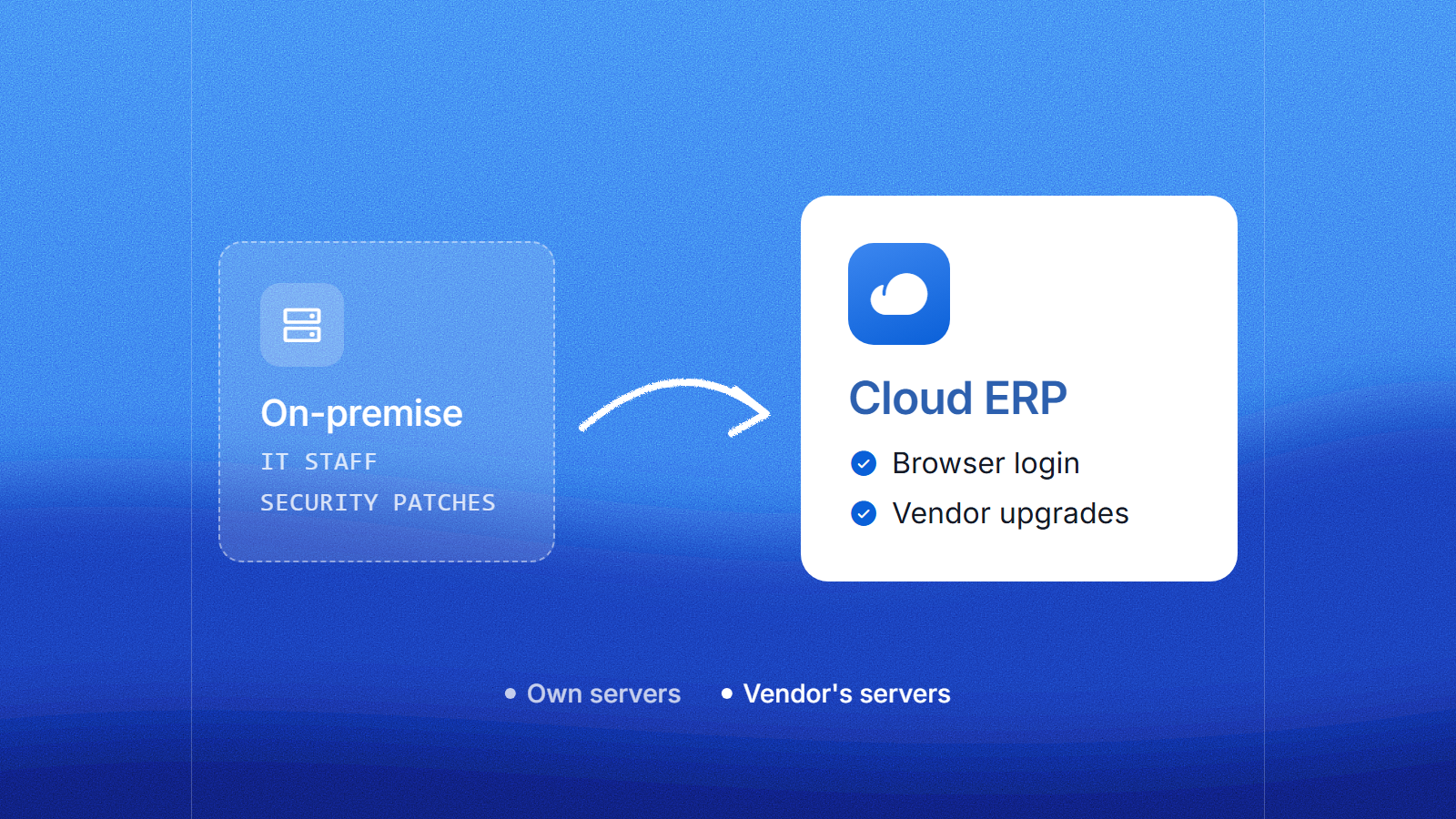
This is different from older ERP software a company installed on its own servers, sometimes called on-premise ERP. With on-premise systems the company’s own IT staff is responsible for the hardware, security patches, backups and all the upgrades. Those jobs are outsourced to the vendor, with cloud ERP included in the subscription fee.
Today, most buyers looking at cloud ERP are comparing specific products, not the idea in the abstract. Vendors such as NetSuite, Microsoft Dynamics 365, Acumatica and Sage Intacct are all cloud-native or cloud-first platforms built around this subscription delivery model, and they compete fiercely on how much of the operational burden they take off a buyer’s plate.
How Cloud ERP Works Under the Hood
How does Cloud ERP work? Cloud ERP separates the software you use from the infrastructure that runs it. The vendor maintains a database of your company’s financial, inventory, order and HR data. Every time you log in, you’re pulling and pushing data to that remote database over an encrypted internet connection, not to a server down the hall.
Multi-Tenant Architecture vs Single-Tenant
Most cloud ERP platforms are built on either of two architectures. Cloud ERP architecture can be multi-tenant or single-tenant. Multi-tenant means that customers share a software instance, but data is logically separated. With a multi-tenant architecture, your company’s data is on the same underlying system as other customers, but is isolated through security controls, rather than physical hardware. In the single-tenant environment, your company gets its own environment, which is typically more expensive, but isolation is tighter.
With multi-tenant SaaS ERPs data isolation is typically done through logical separation (row level security, schema separation etc) while single tenant deployments provide physical isolation with each customer’s data in a separate database or server environment. There is no right answer for either model; it all depends on how strict your industry’s compliance requirements are and how much customization is required.
Where Your Data Really Lives
In almost every cloud ERP contract, the vendor does the operational work that used to be the responsibility of internal IT. The vendor takes care of servers, storage, backups, disaster recovery, security patching and upgrades. That’s the basic trade off that a buyer is making, to give up some control over timing of infrastructure, so as to avoid staffing a server room.