Urgent care clinics run on a different clock than a typical primary care office. Patients walk in unannounced, visits average under 30 minutes, and billing often mixes commercial insurance with occupational medicine and workers’ compensation codes. That mismatch is why a generic EMR built for scheduled primary care visits frequently slows down front desk staff and costs clinics revenue on employer billing.
The best EMR for urgent care needs walk-in intake tools, a real-time tracking board, and billing profiles that handle occupational medicine claims without manual workarounds. This guide compares seven platforms, including athenahealth, eClinicalWorks, AdvancedMD, Tebra, and DrChrono, on pricing, urgent care specific features, and fit by clinic size.
The global urgent care EMR software market was valued at $1.25 billion in 2025 and is projected to expand to $2.78 billion by 2033, a signal that vendors are investing more in urgent-care-specific modules rather than treating the segment as an afterthought.
Best EMR for Urgent Care: Quick Comparison
Before going deep into each vendor, here is how the top five stack up on the features urgent care buyers ask about most: walk-in intake, occupational medicine billing, and starting price.
| Vendor | Walk-in / Tracking Board | Occ Med / Workers Comp Billing | Starting Price |
|---|---|---|---|
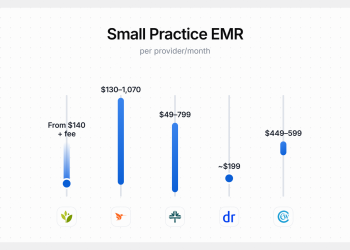
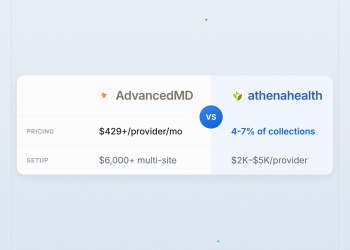
| athenahealth | Configurable, not purpose-built | Configurable | $140/provider/month plus 4 to 7% of collections |
| eClinicalWorks | Yes, native tracking board | Yes, native | Custom quote |
| AdvancedMD | Configurable via PM module | Supported, add-on | $429/month |
| Tebra | Basic intake forms | Supported, limited | Custom quote |
| DrChrono | Yes, native UrgentCare EHR | Yes, native | Custom quote, from $199 |
Source: vendor sites and SoftwareFinder pricing pages, 2026.
1. eClinicalWorks: Best for Unified Walk-In Workflows
eClinicalWorks
eClinicalWorks built a dedicated urgent care and occupational health product line rather than retrofitting its general EHR. Touch, type, or talk using ambient listening technology to document urgent care and occupational health visits, including laceration repairs with correct CPT codes. For clinics juggling walk-ins and scheduled occupational health exams, that single detail saves real documentation time per encounter.
The platform’s tracking board tracks patient orders, displays out-of-range vitals, and monitors patient wait times in real time, which is the core feature urgent care managers look for when comparing systems. Check-in is equally built for walk-ins: patients can view clinic wait times on the website and check in via smartphone or an in-office kiosk.
eClinicalWorks does not publish flat urgent care pricing publicly, so clinics should request a quote scoped to the occupational health module specifically. Compare the full profile on the eClinicalWorks vendor page.
2. DrChrono: Best for Clinics Wanting a Purpose-Built UrgentCare Module
DrChrono
DrChrono is one of the few vendors that shipped a product literally named for this segment. Drchrono unveiled the drchrono UrgentCare EHR, which includes practice management and EHR features built specifically for urgent care practices.
The feature list reads like a buyer’s checklist: prebuilt charting forms for common urgent care conditions, macro text shortcuts that expand to speed urgent care charting, online scheduling, a virtual waiting room queue with patient wait times, iPad kiosk waiting room self-check-in, mobile app patient self-check-in, urgent care patient profiles, and urgent care billing profiles. The custom appointment status feature is particularly useful for tracking flow: clinics can create custom appointment statuses relevant to their workflow and build statuses that indicate where a patient is in terms of appointment steps and exam room location.
DrChrono has historically quoted plans starting near $199, though current pricing is quote-based. Review the vendor directly through the DrChrono profile.
3. athenahealth: Best for Multi-Site Urgent Care Chains with Heavy Billing Volume
athenahealth
athenahealth (owned by Oracle Health’s parent competitor, not to be confused with Oracle Health, formerly Cerner) is not built around walk-in templates out of the box, but its revenue cycle depth makes it a contender for chains with many locations and high claim volume.
Athenahealth EMR cost starts at an estimated $140 per provider per month for the base EHR license, with a revenue cycle management fee of roughly 4% to 7% of monthly collections on top. For a clinic collecting meaningfully more per month across sites, that percentage model can outweigh the lack of native urgent-care templates, especially since athenahealth publishes no fixed pricing and every contract is quoted around practice size, specialty, and the modules selected.
Clinics evaluating athenahealth for urgent care should ask specifically how walk-in scheduling and occupational medicine billing are configured, since these are not native modules. See current details on the athenaOne vendor page.
4. AdvancedMD: Best for Independent Urgent Care Clinics That Want Modular Pricing
AdvancedMD
AdvancedMD lists urgent care explicitly among its supported specialties. AdvancedMD is particularly well suited for dermatology, orthopedics, pain management, primary care and mental health practices, and it also supports a wide range of other specialties, including cardiology, OB/GYN, urgent care, and physical therapy.
Pricing is modular rather than bundled by default. Medical specialty pricing ranges $429 to $1,070 per provider per month, and practices can combine EHR, practice management, and patient engagement software to save up to 40 percent compared with purchasing the products individually. Independent urgent care clinics with a single location often find this bundling approach more predictable than percentage-of-collections pricing.
Clinics with lower patient volumes have another option: encounter-based pricing lets practices pay per encounter instead of a flat monthly subscription, with bundled practice management and EHR pricing ranging from $1.08 to $2.17 per claim. Full pricing breakdown is on the AdvancedMD vendor page.
5. Tebra: Best for Budget-Conscious Startup Urgent Care Clinics
Tebra
Tebra, formerly Kareo, leans toward independent and newer practices. It is popular with independent urgent care clinics or startup practices where budget is a big factor, with pricing that tends to be moderate and lets clinics avoid paying for extra modules they won’t use.
Tebra’s urgent care page confirms the specialty focus directly: the urgent care offering features rapid charting for high-volume visits and occupational health forms. That said, Tebra’s patient engagement layer is lighter than larger competitors: it offers a patient portal and engagement tools like reminders, but these aren’t as advanced as some larger systems.
Tebra does not publish flat pricing, so request a quote scoped to urgent care and occupational health forms specifically. Review the Tebra vendor page for current details.