The rollout of Epic at a single hospital can cost more than the annual health budget of a small country, while a solo physician down the street pays a few hundred dollars a month for a cloud EHR that does the same basic job of storing patient records.” The first thing to understand about EHR software cost is that gap.
EHR software cost in 2026 varies from about $200 to $700 per provider per month for cloud-based small practice systems to $10 million to $30 million or more for hospital-level Epic or Oracle Health implementations. Community hospitals and single facilities often experience Epic implementation costs ranging from $10 million to $30 million for full deployment over a period of several years.
Buyers looking for EHR software, instead of just EMR tools, are generally looking at enterprise-grade platforms designed for interoperability across departments and facilities. That changes the pricing conversation completely vs a single location EMR guide.
This guide breaks down EHR software costs by practice size, so you can budget for your own practice, not a generic average.
How Much Does EHR Software Cost by Practice Size
Pricing for EHR software does not move in a straight line as you add providers. A solo practice and a 300 bed hospital are buying fundamentally different products, even when the vendor name is the same.
| Practice Size | Typical Monthly Cost | Typical First-Year Cost |
|---|---|---|
| Solo practice (1 provider) | $200 to $700/provider | $4,000 to $15,000 |
| Small practice (2 to 5 providers) | $400 to $3,500 | $15,000 to $65,000 |
| Medium practice (6 to 20 providers) | $1,200 to $12,000 | $65,000 to $200,000+ |
| Enterprise / Health System | Custom Quote | $10 million to $30 million+ |
Source: PracticeEHR, 2026; Software Finder, 2026.
Solo and small practice
At this size, buyers are more inclined to prefer cloud SaaS pricing, as opposed to enterprise platforms. Subscription-based small-practice EHR systems are typically in the $100-600 range per provider, per month, and implementation is through standard onboarding (not custom consulting).
Medium practices (6-20 providers)
That’s where per-provider pricing doesn’t scale well. A practice at this size starts to need more interfaces, more training hours, and often a dedicated implementation team. That’s why you can see first-year costs of $200,000-plus even without an enterprise vendor.
Enterprise, hospital systems
Here the pricing model is completely different – no per provider fees. Epic and Oracle Health price by bed count, user role, and module scope and negotiate contracts individually rather than publish them.
How Much did Oracle Health and athenahealth Really Cost
When buyers are specifically looking at EHR software cost, they are almost always comparing these three names, so it helps to see how their pricing models differ.
Epic
Epic’s licensing anchors are $5,000 to $7,000 per physician user, $3,000 to $5,000 per other clinical staff user and $500 to $1,000 per hospital bed. Small clinics usually pay $100,000 to $300,000 to begin, then $4,000 to $12,000 a month for hosting and support. At the health system level, regional health systems with multiple hospitals typically spend more than $50 million, sometimes as much as $150 million or more. Epic has nearly a 38 percent share of the hospital market for systems with 500 beds or more, and it costs a mid-size health system typically $150 million to $300 million to implement over 10 years when all direct and indirect costs are included.
Oracle Healthcare
Oracle Health, the platform formerly known as Cerner, has a similar enterprise pricing model to Epic, with negotiated contracts based on bed count and module, and implementation typically in the seven figures for hospital-sized deployments. Published third party estimates have put Cerner-based implementations at $1,000,000 or more for base implementation alone, excluding infrastructure and staff training.
athenahealth prices differently than pure per-seat competitors. The model is not a flat fee, but rather a base fee of approximately $140 per provider per month, plus 3 to 7 percent of collections, so the actual monthly cost depends on how much revenue a practice generates. For a busy practice that collections based fee can be larger than the base subscription.
What’s Behind The Monthly Fee For EHR Software
The per-provider rate advertized is rarely the entire story. Some cost drivers can routinely double or triple a vendor’s initial quote.
Deployment and configuration
For small practices, implementation, data migration, staff training and integrations are usually charged separately from the monthly subscription. This setup fee alone has been quoted at $65,000 to $200,000 for mid-size practices.
Integrations and Interfaces
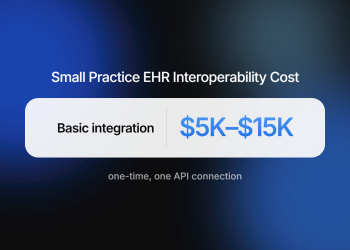
Each interface from an EHR to a lab system, imaging system or billing platform can cost $5,000 to $25,000, and a hospital could need 50 to 200 of them. For enterprise buyers integration costs can blow out to more than the licence fee itself.
Model of Licensing
SaaS subscriptions have a different cost structure up front than perpetual, self-hosted licensing. Public estimates of the combined cost of software purchase and implementation for perpetual licensing range from $15,000 to $70,000 per provider, a cost that cloud subscribers amortise over time instead of paying all at once.
EHR vs. EMR Cost: Why the Price Is Different
When buyers type ehr software cost instead of emr software cost, they are typically, whether they know it or not, shopping in a different tier of the market. EMR tools are often designed to chart in a single location. The interoperability layer that drives up the price of EHR platforms like Epic, Oracle Health, and athenahealth is their built-in ability to share records across facilities, specialities, and sometimes regions.
The difference is evident in the numbers. A solo practice EMR might run $200 per month. The same vendor’s enterprise-level hospital-grade EHR deployment can cost eight figures. Even if the marketing language is similar, the features, the support, the length of the contract are not comparable.
FAQs
What is the cost of EHR software per provider per month?
Cloud based EHR software for small and mid-size practices is generally between $200 and $700 per provider per month, which includes core charting, hosting and support. Enterprise systems like Epic or Oracle Health are not priced per provider per month at all. They are quoted as multi-year contracts that can run into the millions depending on bed count and modules.
So, is EHR software more expensive than EMR software?
Not naturally. While the terms overlap a lot in marketing, the EHR label tends to stick to the larger, interoperable platforms like Epic, Oracle Health and athenahealth that serve hospitals and multi-location groups, which pushes the quoted price ranges higher than typical single-location EMR tools aimed at solo providers.
What’s the cheapest EHR for a small practice?
When shopping for EHRs in particular, buyers compare enterprise-grade vendors, and athenahealth is often the most accessible entry point for small practices, with published estimates pointing to a base fee of around $140 per provider per month plus a percentage of collections, rather than Epic or Oracle Health, which rarely quote less than six figures even for small clinics.
Epic charges for each bed or each provider.
Epic uses both models depending on deployment . Hospitals typically price by bed, with licensing often estimated at $500 to $1,000 per bed. Ambulatory and physician-facing modules are per user, with physician seats estimated at $5,000 to $7,000 each.
Why is the cost of EHR implementations so different from vendor to vendor?
The spread is there because practice size, number of interfaces, hosting model and training needs change the bill far more than the base licence. A 5 provider clinic and a 300 bed hospital are not buying the same product regardless of whether it is both labelled EHR Quotes must therefore be compared by organization size and not just vendor name