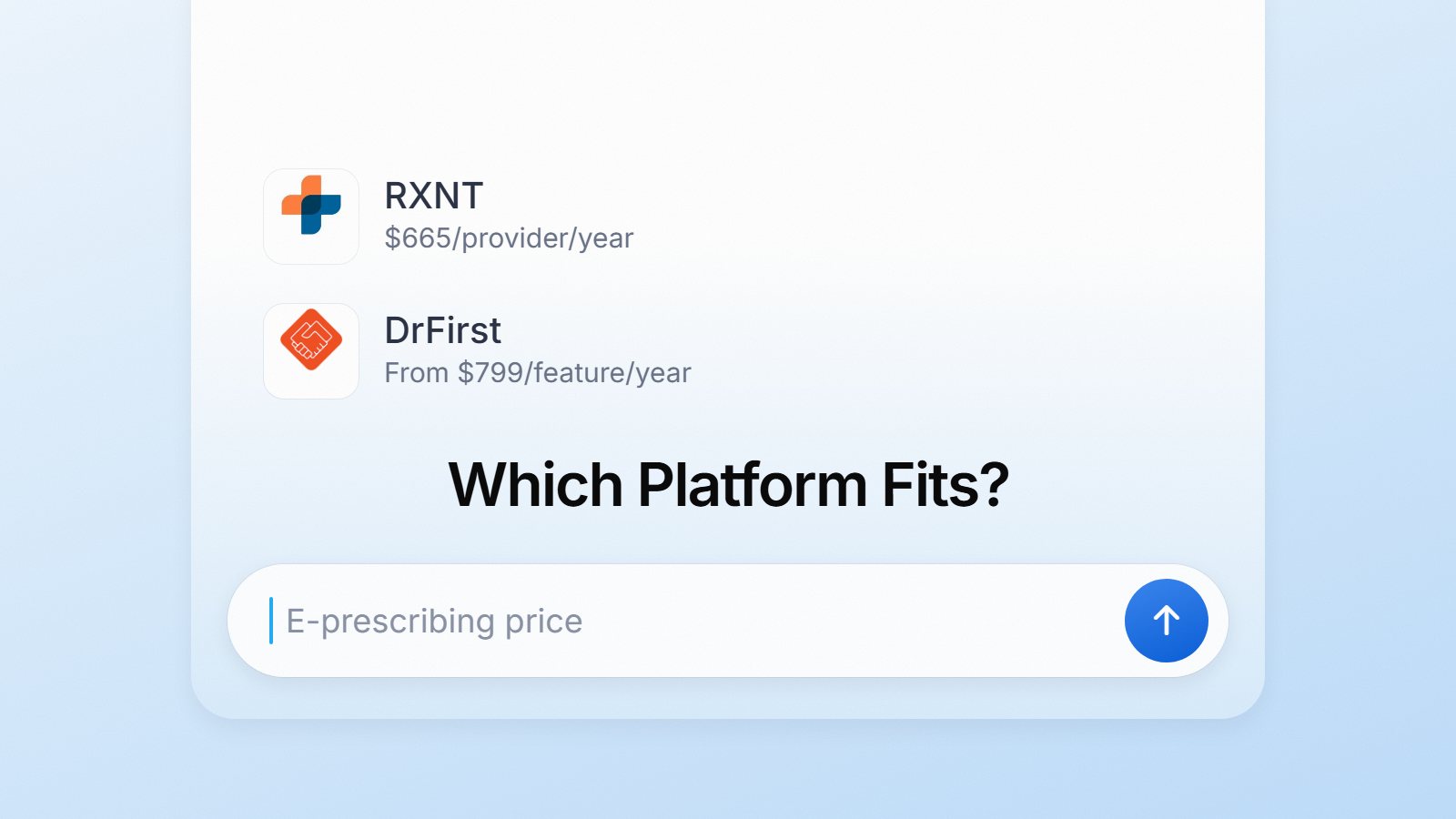
Vendor and third-party pricing pages show that RXNT charges $665 per provider per year for stand-alone e-prescribing and DrFirst’s Rcopia starts at $799 per feature per year. That gap is more important than it seems, because the two platforms are built for different kinds of practice. This guide tells you the real difference between rxnt vs drfirst so you can stop guessing and get to the comparison.
A common choice for small clinics is RXNT, as it offers e-prescribing as well as billing, scheduling, and an EHR. Larger groups and hospitals tend to go with DrFirst, because Rcopia was built to plug into existing systems at scale. Software Finder already compares DrFirst to DoseSpot elsewhere, but buyers keep asking how RXNT stacks up against DrFirst specifically, especially for solo and small group practices.
Straight answer: Both RXNT and DrFirst sign BAAs and provide EPCS-certified e-prescribing, but RXNT is priced as a flat, published subscription for small to mid-size practices, and DrFirst Rcopia is quoted per feature with less public pricing, and built for larger health systems who need deep EHR integration.
RXNT vs DrFirst: Key Differences Buyers Ask About
The first question most buyers ask: does either platform handle controlled substances? They both do, but the road to get there looks different.
RXNT
RXNT’s e-prescribing feature is certified for EPCS, allowing providers to securely write Class II-V medications from any device. The cost is $665 per licence per year for stand-alone e-prescribing. For controlled substance prescribing, ID proofing and biometric authentication are required for an additional $85 per licence per year. RXNT also has Ambient IQ, an AI-powered scribe that listens to patient visits and turns them into a clinical note, saving the time that would otherwise be spent documenting manually.
DrFirst
Medication management leader in the industry for over 21 years. Pioneered EPCS with the DEA, myBenefitCheck and artificial intelligence in medication management. Dr. First offers Healthcare Compliance and EPCS Compliant capabilities, two of the most desired features in this category, with EPCS Compliant meaning it meets the DEA’s Electronic Prescriptions for Controlled Substances regulations. The target user audience of DrFirst Rcopia is large-sized organisations like hospitals and large private clinics.
That last point is the real line in the sand. RXNT sells directly to independent practices. DrFirst’s own positioning and reviewer base leans more toward hospital systems and multi-specialty groups that require a prescribing layer wired into an existing EHR stack.
RXNT E-Prescribing Pricing Summary
RXNT is one of the few vendors in this category to publish their pricing upfront. EHR Bundle $126 per provider per month Practice Management $213 per provider per month Full Suite Bundle $335 per provider per month Standalone E-Prescribing Billed annually at $665 per provider per year
| Plan | Price | What’s Included |
|---|---|---|
| EHR Bundle | $126/provider/month | EHR, e-prescribing, scheduling, patient portal |
| Practice Management | $213/provider/month | Billing, scheduling, mobile apps |
| Full Suite | $335/provider/month | EHR, billing, scheduling, e-prescribing, portal |
| Standalone E-Prescribing | $665/provider/year | EPCS, drug interaction checks, mobile e-prescribing |
Source: Capterra and G2, 2026.
RXNT pricing is free setup and training, free data transfer, free in-house support, free mobile applications and no hidden fees. Software Advice states RXNT pricing. This matters to small practices comparing total costs, as implementation fees elsewhere can add thousands of dollars before the first prescription is written.
DrFirst E-Prescribing Pricing Overview
DrFirst is more difficult to pin down on pricing. Dr. First’s Basic plan costs $799 per feature per year. Rcopia doesn’t publicly share pricing, so if you’re interested you’ll need to contact DrFirst directly for a custom quote. The final cost will depend on the number of providers, the size of the practice, and the features the practice needs.
For larger deployments, the costs of implementation can add up quickly. Implementation, customisation, training and migration costs vary from case to case, perhaps from a few thousand dollars for a small practice up to tens of thousands for a large enterprise with an SMB typically paying between $5,000 and $15,000 for initial setup and training.
Older Context Rcopia Pricing
Historical pricing references give some sense of how DrFirst has organised tiers over time. Noncontrolled substance e-prescribing has begun at $28/month/user or $336/year and controlled substance EPCS access has begun at $35/month or $420/year on older published rate sheets. That base is well above current enterprise quotes for Rcopia+EPCS Gold, which is why most buyers now need to request a custom quote.
RXNT vs. DrFirst: Integration Takes Center Stage
RXNT is built as an integrated suite, so e-prescribing, billing, scheduling and EHR all share one login and one database. This is fine if a practice wants to run everything on one system but is limiting if the practice already owns a different EHR and only wants a prescribing module bolted on.
DrFirst is a little different. It’s why many large health systems with existing EHR investments prefer DrFirst Rcopia over a bundled suite, as practices can connect it to their existing patient management systems thanks to API integrations. The tradeoff is that integration work, training and migration are typically quoted separately and not baked into a flat subscription.
What platform is right for your practice
- Choose RXNT if: You’re a small to mid-size practice that wants one connected system for prescribing, billing and records. You like flat, published pricing with no custom quote process.
- If you’re a hospital, health system or large multi-specialty group with a separate EHR and need an e-prescribing layer that integrates via APIs rather than replacing your existing stack, then DrFirst is for you.
- If you’re an EHR vendor or digital health company looking to embed e-prescribing directly into your own product (rather than adopting either RXNT or DrFirst as a standalone application), consider DoseSpot as another option.
Frequently Asked Questions FAQs
Is RXNT cheaper than DrFirst for e-prescribing?
Yes, generally in most comparisons. RXNT’s standalone e-prescribing module is $665 per provider per year, while DrFirst’s Rcopia starts at $799 per feature per year. RXNT also offers e-prescribing in its EHR plan for $126 per provider per month, which can reduce the effective cost for practices that need a full EHR anyway.
Does RXNT provide EPCS certification?
E-prescribing Module RXNT’s EPCS-certified e-prescribing module allows providers to prescribe Schedule II through V controlled substances from their desktop or mobile device. RXNT bills ID proofing and biometric authentication separately from the base e-prescribing subscription for $85 per licence per year when prescribing controlled substances.
Which is more easily integrated with existing EHRs. RXNT or DrFirst?
Why do hospitals and large health systems use DrFirst’s Rcopia? Rcopia is primarily built out as an integration layer and connects directly to a practice’s existing EHR through API connections. RXNT is best used as part of its own connected EHR, billing and scheduling suite, so practices already using another EHR may find DrFirst or DoseSpot easier to bolt on.
Can RXNT or DrFirst be used by small practices?
DrFirst is aimed at hospitals and larger private practices, although it can be used by small practices too. The pricing is not available on the website, making it harder to budget for. RXNT has flat pricing per provider and does direct advertising to independent clinics and solo physicians, which makes it generally the easier pick for smaller teams.
If not, does RXNT or DrFirst have better alternative EHR software options?
If both RXNT and DrFirst seem like a bad fit, then the third big one to compare is DoseSpot. DoseSpot is designed more as an embeddable e-prescribing API for EHR vendors than a standalone e-prescribing system. So the right tool for the job depends on whether a practice wants a bundled suite, a hospital-grade integration layer or a lightweight API.
Choosing Between RXNT and DrFirst in 2026
The choice usually comes down to practice size and what you already have in place. Independent practices and small groups that need a single system for prescribing, billing, and records usually choose RXNT because its pricing is published and setup is included. Hospitals and larger systems that have an existing EHR that they need to maintain and want to layer a compliant prescribing system on top of, tend to gravitate to DrFirst, even with the custom quote process.
Before you sign a contract with either vendor, request a line-item quote that separates the cost of the subscription from implementation and training fees. See side-by-side feature comparisons, user ratings, and verified pricing for RXNT, DrFirst, and DoseSpot on the Software Finder e-prescribing hub.