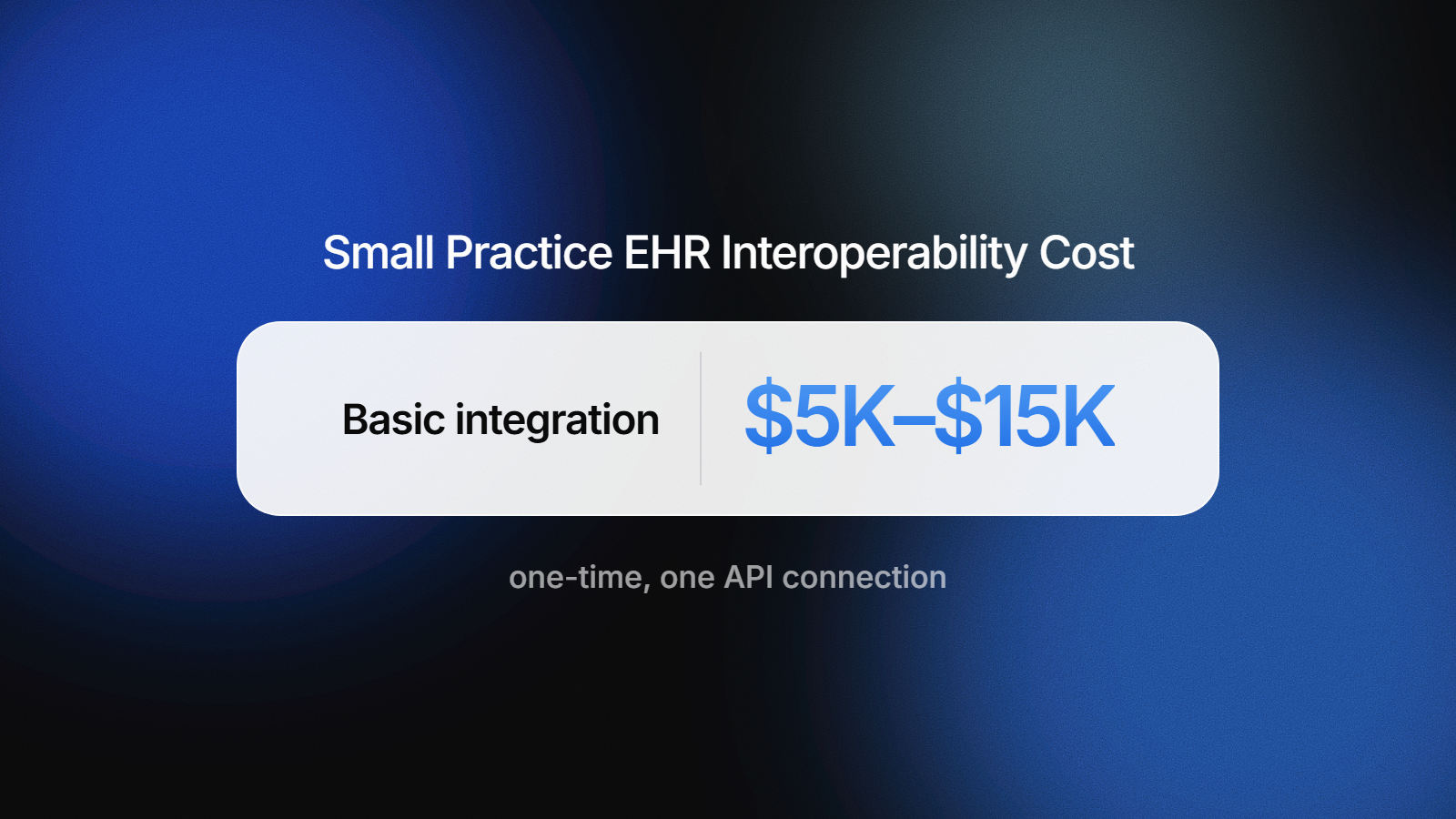
One industry veteran says it can cost a small practice anywhere from $5,000 to $15,000 just to get two systems talking to each other, and that is before the annual maintenance bill arrives.
Interoperability is the part of EHR shopping that gets skipped by most pricing pages. Vendors advertize a per-provider monthly rate, then interoperability fees pop up later as a line item for connecting to labs, hospitals, health information exchanges or a TEFCA-aligned network.
For a small practice, basic EHR interoperability costs $3,000 to $25,000 per connection, plus $3,000 to $15,000 a year per interface for ongoing maintenance. Some vendors, like athenahealth, automatically plug practices into a secure, nationwide network with no additional work or costs. Other vendors expect practices to handle and pay for integrations on their own.
What Drives the Cost of EHR Interoperability for Small Practices
Interoperability is not a cost single fee. It’s a list of smaller fees, based on how many systems you connect to, how much data is flowing, and whether the exchange is one way or both ways.
A basic integration with one API connection and read-only data access runs $5,000 to $15,000; mid-level bi-directional data exchange with several endpoints, $15,000 to $30,000; and complex multi-system interoperability for hospitals, $30,000 or more. At the low end is a solo practice hooked up to one lab and one e-prescribing network. A multi-provider practice that shares records with a hospital system and a health information exchange is in the middle tier.
Most buyers miss the cost of maintenance. Vendors think of integrations as a one-time cost, but each interface has a recurring maintenance cost of between $3,000 and $15,000 per year. At that price, five interfaces can burn through money quickly. It’s why practices that connect to multiple labs, pharmacies and referral networks often find their total spend on interoperability has doubled in two years.
Interface and Portal Fees by Type
| Connection type | Typical one-time cost | Annual maintenance |
|---|---|---|
| Basic single API, read-only | $5,000 to $15,000 | $3,000 to $15,000 |
| Bi-directional, multiple endpoints | $15,000 to $30,000 | $3,000 to $15,000 per interface |
| Patient portal (read-write) | $3,000 to $20,000 | Included or billed separately by vendor |
| FHIR API / interoperability fee | N/A | $1,000 to $10,000+ per year, per integration |
Source: Thinkitive, Greensighter, Topflightapps, 2026.
Typically, portal integration costs $3,000 to $20,000 per connection, depending on whether the patient can only read data or also write data back. Other line items that catch practices off guard are data migration at $5,000 to $50,000 by record volume and FHIR API fees of $1,000 to $10,000 or more per year per integration.
EHR Data Exchange Requirements for 2026
Buyers now believe that participation in TEFCA is required. No it is not. Today, QHIN participation is voluntary and TEFCA connectivity is not required by ONC certification criteria or the information blocking rule at 45 CFR Part 171. Instead, certified EHR technology must support the following standards: USCDI data classes, the Patient Access API and related FHIR-based APIs and exchange capabilities tied to the ONC Health IT Certification Program.
That difference matters for budgeting. There’s no fee to join a Qualified Health Information Network and stay compliant, but your certified EHR still needs to support the underlying FHIR standards, and some vendors pass that engineering cost through subscription tiers or per-connection fees.
Many organisations, especially small and rural providers, have expressed cost concerns to the federal government, which continues to develop strategies to assist them with TEFCA implementation. If you’re a 1 to 5 provider practice, ask any vendor directly if TEFCA connectivity is bundled or billed as an add-on before you sign a contract.
TEFCA Pricing for Participating Practice
Participation in TEFCA and becoming part of a QHIN network often requires a significant initial investment, ranging from infrastructure upgrades to security and governance requirements, and some organisations find the initial costs associated with compliance, technical onboarding, and workforce training to be challenging. Smaller practices and those that are underfunded may be challenged to adopt TEFCA due to the technical complexity and resource requirements, as many are still on older systems and lack the IT support to connect to a QHIN.
This is where vendor selection seems more important than it does on a price sheet. A practice on a platform that is already a QHIN participant avoids most of that onboarding cost altogether.
Comparison of Vendor Interoperability Policies
Not all EHR vendors are the same in terms of data exchange. Some have network connectivity as part of the base subscription. Others charge per interface.
athenahealth athenaOne is fully TEFCA-aligned through CommonWell Health Alliance, a federally designated Qualified Health Information Network and has been facilitating nationwide data exchange for more than a decade. Other vendors may charge practices to manage and pay for integrations themselves, but the company claims it also automatically integrates with other practices without any extra work or additional fees. Compare current plans on the profile of athenahealth.
Epic
Most small practices access Epic through a hosted model that starts at about $200 per user per month, or by joining a larger health system’s instance through Epic Community Connect, which is often the only financially viable path for independent clinics. Community Connect is a good way to shift the interoperability burden from the small practice to the host system. See the Epic profile details.
Oracle Healthcare
Oracle Health (formerly Cerner) generally deals more with hospital systems and larger ambulatory groups than solo practices, and terms of interoperability are typically negotiated as part of an enterprise contract rather than published rates. See the Oracle Health profile for the latest offerings.
eClinical Works
A solo doctor using a cloud-based system such as eClinicalWorks, which costs roughly $449 to $599 a month per provider, can be at the low end of first-year costs, although most practices fall in the middle range once you factor in the implementation work and training. See eClinicalWorks profile for current data exchange terms.
NextGen
NextGen offers ambulatory and speciality practices and publishes interoperability capabilities to ONC certification requirements, but fees for each interface vary by module and speciality package. See NextGen profile for current terms.
The Costs of Your First Year in Solo or Small-Firm Practice
Typical software licensing for a 1 to 5 provider practice is $4,800 to $36,000 per year, implementation and configuration is $5,000 to $40,000, data migration is $2,000 to $20,000 and interface or integration work for one to three connections is $3,000 to $25,000, for a realistic first-year total of $18,300 to $158,000.
Where a practice falls in that range depends almost entirely on how many systems it needs to connect, and whether the vendor bundles network connectivity or charges per interface.
Frequently Asked Questions
What is EHR interoperability—and why does it cost extra?
EHR interoperability means your system can share patient records with labs, hospitals, pharmacies and other EHR systems. This is an extra cost because each connection (or interface, as it is often called) requires custom mapping, testing, and ongoing maintenance that is not included in most base EHR subscriptions.
Does TEFCA compliance apply to small practices?
Participation in the QHIN under TEFCA is voluntary and not mandated by the federal government. ONC certification and the information blocking rule specify technical capabilities such as USCDI data classes and FHIR-based APIs but do not specify membership in a Qualified Health Information Network.
What do EHR vendors charge for data sharing?
“Policies depend on vendors.” athenahealth provides TEFCA connectivity through CommonWell at no extra charge, but other vendors may require practices to pay for and maintain separate point-to-point integrations that could cost $5,000 to $15,000 for a simple connection.
What is the average price for one EHR interface?
Basic integrations with a single API connection and read-only access usually range from $5K to $15K. Mid-level bi-directional connections with multiple endpoints range from $15,000 to $30,000, with an annual interface maintenance fee of $3,000 to $15,000 per interface.
Can one practice totally avoid interoperability costs?
Not entirely, but it can cut down on them by selecting a vendor that has built-in network connectivity instead of paying for custom interfaces. Practices that choose EHRs that are already connected to a QHIN do not have to pay the $1,000 to $10,000 per year FHIR API fees that come with standalone integrations.