The cost of adding e-prescribing to a single-provider practice can range from $30 per month to $665 per year, depending on whether the tool is standalone or bundled into a full EHR. That gap throws a lot of buyers who think e-prescribing has a standard price. It doesn’t.
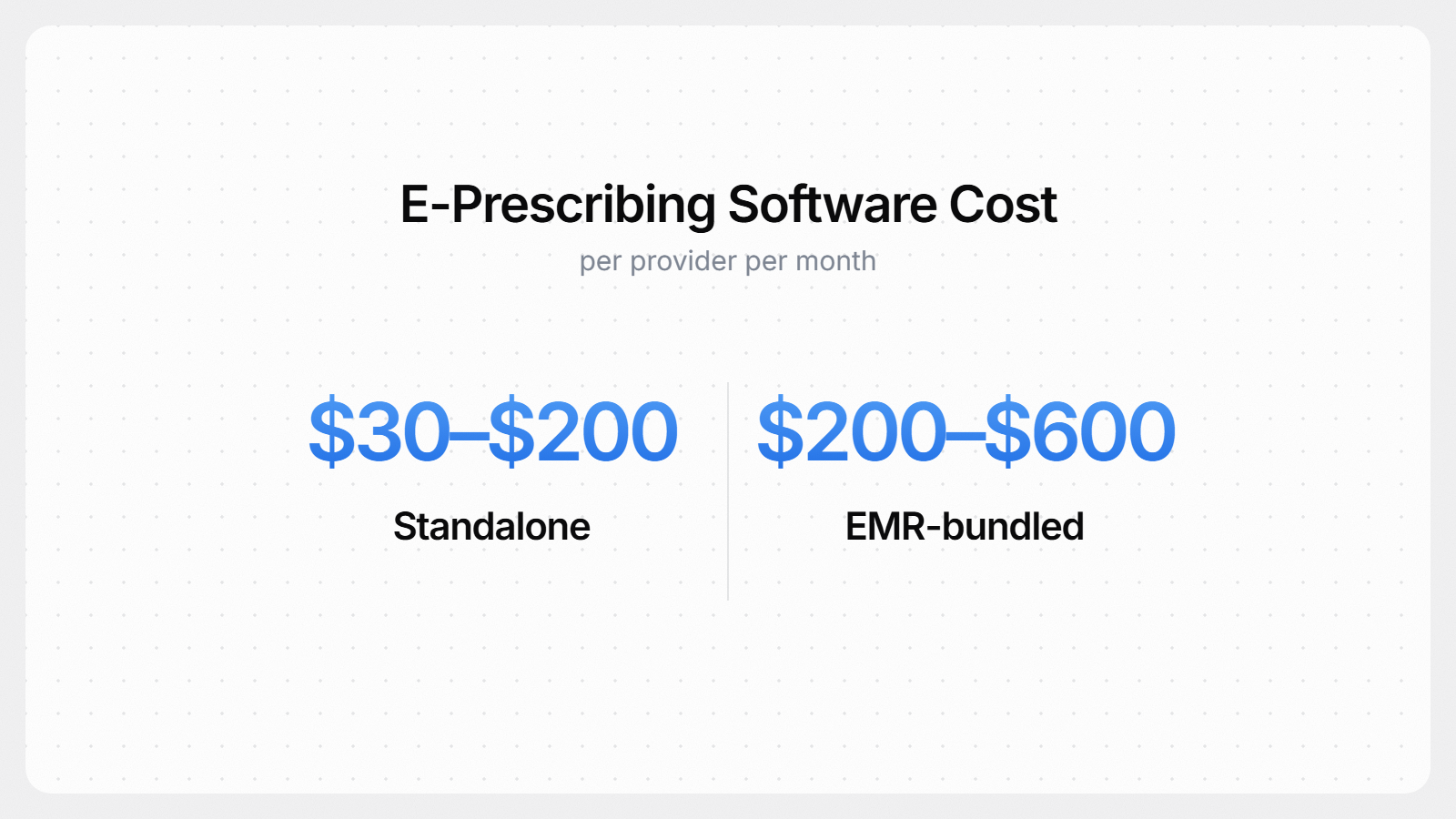
Stand-alone e-prescribing software costs between $30 and $200 per provider per month, while bundled EMR plans with e-prescribing are generally priced at $200 to $600 per provider per month. Setup fees and EPCS identity proofing may add $35 to $2,000 one time, based on the vendor and whether controlled substance prescribing is required.
This guide cuts through the noise and reviews the actual 2026 pricing from vendors and review sites so you know what to expect to pay before you get on a sales call.
For example, Software Finder also breaks down EPCS pricing separately if you are looking specifically for controlled substance prescribing. The broader question this article tackles is the expense of e-prescribing in independent tools and EMR-integrated systems.
Factors Affecting E-Prescribing Software Cost in 2026
What moves the price up or down is: 1) if the tool is standalone or part of a full EHR, 2) if it handles controlled substances (EPCS), and 3) how many providers are on the account.
Stand Alone vs. Bundled
Standalone e-prescribing tools that plug into an existing workflow tend to be less expensive. Third-party sources put DoseSpot’s entry-level price at $75 a month plus a $2,000 one-time implementation fee. Other light-weight tools cost less. MDToolbox subscriptions start at $30 per prescriber per month.
EMR-bundled e-prescribing costs more, because you’re paying for the whole platform, not just the prescribing module. DrChrono offers e-prescribing support, bundled at $250 to $350 a month per provider, and 50% less if encounters are fewer than 75 a month.
EPCS Levies Separate Fee
You almost always pay extra to prescribe controlled substances. For a single dental integration, DoseSpot charges $40/month per provider for basic prescriptions and $55/month per provider for controlled substance capability, plus a $75 one-time setup fee per provider. EPCS identity proofing is generally a one-time fee in addition to that.
Revenue-based pricing for complete EHR suites
Some larger platforms eliminate flat per-provider pricing altogether. athenahealth uses a “percentage-of-collections” model, typically 4 to 7 percent, to align vendor incentives with practice revenue. So your e-prescribing expense is rolled into a bill that goes up with how much your practice bills, not a fixed monthly cost.
E-Prescribing Cost Per Provider: Standalone Tools Compared
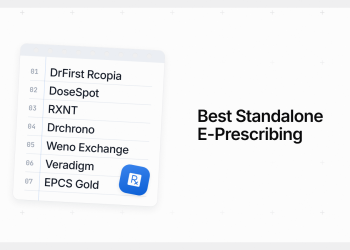
Here is how standalone e-prescribing pricing looks across several widely used tools, based on vendor and review-site data gathered in 2026.
| Vendor | Starting Price | EPCS Included or Add-On | Notes |
|---|---|---|---|
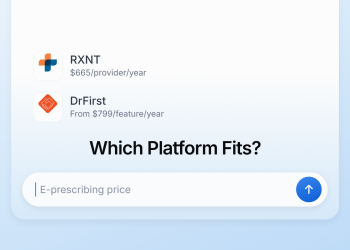
| RXNT | $32/user/month for Scheduling, with E-Prescribing priced at $665/user/year | Add-on module | Full suite bundle available at higher tiers |
| DoseSpot | Estimated at $75/month plus a one-time $2,000 implementation fee | Included in per-prescriber fee on some plans | Vendor does not publish pricing publicly |
| DrFirst | $360 flat annual rate | Additional feature fee | Marketed for real-time medication data |
| MDToolbox-Rx | Starts at $30/month for E-Prescribe Pro, $38/month for E-Prescribe Complete | Included in Complete plan | Add-ons like Visit Notes cost extra |
| Veradigm ePrescribe | From $59/mo per prescriber, sponsored messages included | Listed with the base plan | Tier structure not fully published |
Source: Vendor sites, RXNT, Forbes Advisor, Commure, 2026.
Cost of E-Prescribing when bundled into an EMR or EHR
If you already have a full EHR or plan to buy one, e-prescribing costs will be part of a larger number. Most buyers in this category pay more than the stand-alone users, but get charting, scheduling and billing in the same system.
In the medical market, the vast majority of software buyers spend between $ 200 and $ 600 per provider per month on medical technology. Only a small percentage spend less than $ 200 or more than $ 600. That range reflects the reality that most practices aren’t buying e-prescribing in a vacuum. They’re buying an EHR that just so happens to have it.
Intergy EHR costs $799 per provider per month and includes in-workflow PDMP checks, which is on the high end for a full-featured clinical system with e-prescribing built in. The low end of the scale for RXNT is around $118 per month for the basic package before you add modules.
DrChrono and Practice Fusion
Practice Fusion charges $199 per provider per month for its EHR with EPCS included, with an annual commitment. DrChrono is in a similar range, with per-provider monthly cost for prior authorization and e-prescribing support at $250 to $350, according to third-party research as seen in the table above.
Hidden Costs of E-Prescribing Pricing to Watch
But the sticker price is seldom the whole story. Setup fees, identity verification and PDMP integration charges can tack on hundreds of dollars before the first prescription is written.
A single e-prescribe vendor costs $46.90 per month per provider for up to 500 prescriptions, plus one-time fees of $35 for account setup and $60 for Surescripts Provider ID Verification. Most tools that are EPCS-enabled will require that step of identity verification.
The size of the practice also determines implementation costs. HME and DME providers usually pay $200 to $700 a month for e-prescribing systems, while implementation fees range from $500 to $5,000, based on the size of the organization. Larger practices considering enterprise integrations should expect quotes on the higher end of that range.
Questions and Answers
What is the cost of e-prescribing software per provider per month?
Stand-alone e-prescribing tools typically range from $30 to $200 per provider per month, while e-prescribing software bundled into an EHR or EMR subscription typically costs $200 to $600 per provider per month. Most buyers in this category spend $200 to $600 a month per provider, says Software Advice, although basic stand-alone options cost considerably less.
Do the majority of EMR subscriptions include e-prescribing?
Yes, most EMR platforms (like athenahealth, DrChrono, and Practice Fusion) include e-prescribing in their core subscription and don’t bill for it as a stand-alone line item. Standard e-prescribing is included in the base price, although some vendors still will add an EPCS charge for controlled substances.
Are stand-alone e-prescribing tools cheaper than those bundled with EMRs?
Yes, standalone tools like MDToolbox-Rx and DxScript start at about $30 a month, while EMR-bundled e-prescribing can push total provider costs to $200 to $600 a month when the EHR, billing and scheduling modules are included. Buyers who don’t need a full EHR, but only need prescribing, usually save money with a standalone product.
Why do some vendors charge for prescribing controlled substances using EPCS?
EPCS requires identity proofing, two-factor authentication and compliance with DEA rules, meaning there are additional technical and verification costs that vendors charge as a separate fee. Identity proofing itself can be a one-time charge of $25 to $65 per prescriber, in addition to a monthly EPCS fee that is often $15 to $55 a month.
What to look for in e-prescribing pricing Hidden fees to buyers
Common add-ons include one-time set up or implementation costs, Surescripts identity verification charges, PDMP integration fees, and annual contract obligations that lock in pricing. Some vendors also quote per-year pricing instead of per-month, and this can make a plan look cheaper than it really is until the full annual cost is worked out.