For 2026 medical practices looking to purchase EMR software, prices range from $30 per provider per month for basic cloud platforms to custom enterprise quotes that can exceed $500,000 in year one. The final price will depend on the size of the practice, the deployment model, the specialty needs and how many hidden fees the vendor discloses upfront.
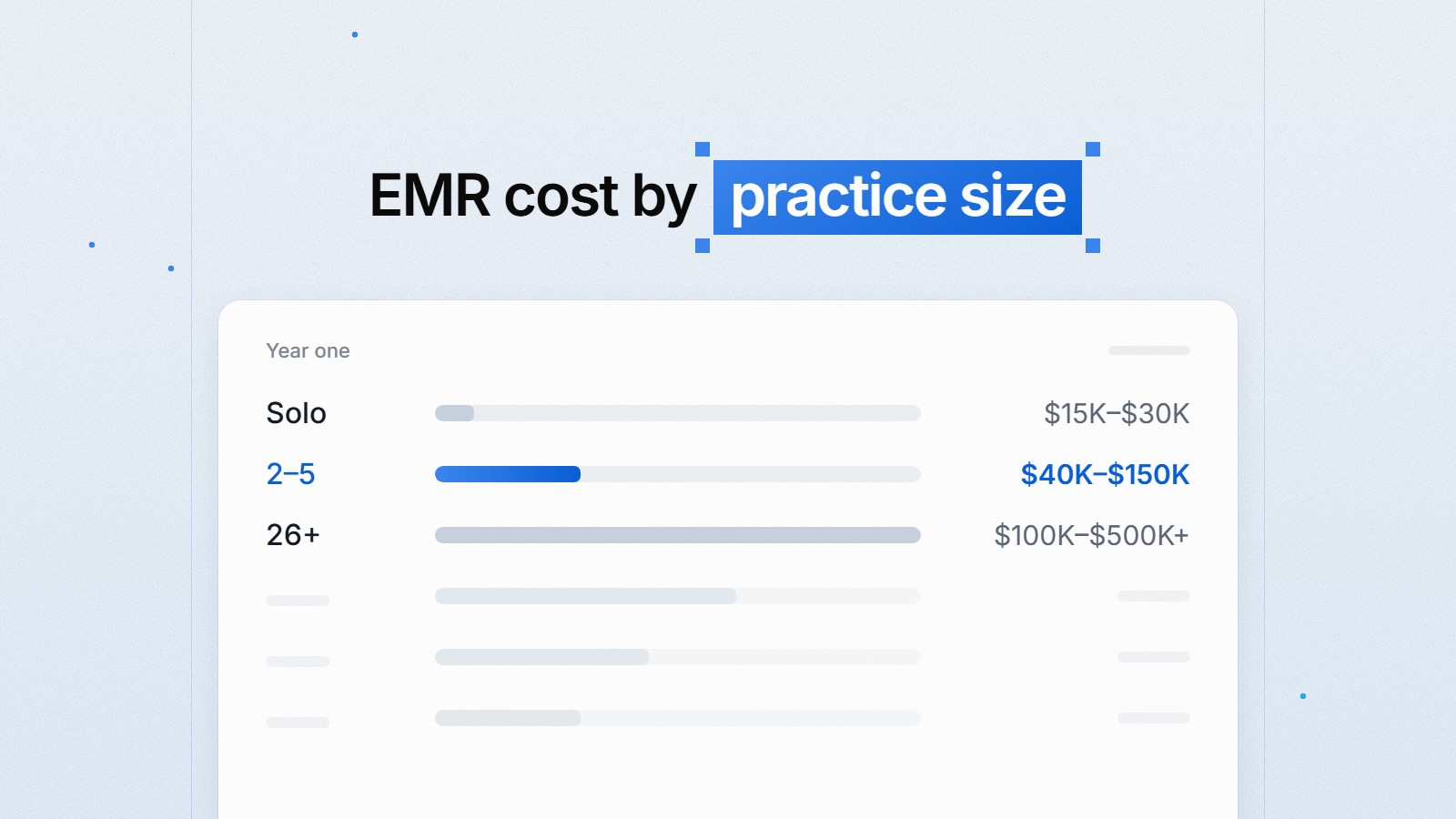
According to GetPracticeHelp’s EHR pricing analysis for 2026, cloud-based EMR software will cost small to mid-sized practices between $200 and $700 per provider per month in 2026. The first year for a solo provider usually runs between $15,000 and $30,000, including subscription, implementation ($5,000-$20,000), training ($1,000-$5,000), and data migration ($2,000-$10,000). Cost Guide for 2026 practices with 2 to 5 providers is $40,000 to $150,000 in year one spend, and organizations with 26 or more providers can cost $100,000 to $500,000 or more.
The published pricing gap is wide because enterprise vendors like Epic and Oracle Health (formerly Cerner) don’t publish rates at all, while small-practice vendors like DrChrono, SimplePractice and RXNT list monthly subscription prices on their own sites. Based on vendor pricing data from verified sources, this guide explains which practices really pay across various vendor tiers, deployment models and practice sizes.
EMR Software Costs by Vendor 2026
Pricing transparency varies widely across the EMR market. • 11 of the 18 vendors surveyed by GetPracticeHelp in June 2026 publish a price on their own website. 7 vendors require a demo or quote request. All published prices below are from vendor official sites visited June 2026, or verified third-party sources where noted.
| Vendor | Monthly Cost per Provider | Pricing Model | Implementation Fee | Source |
|---|---|---|---|---|
| DrChrono | $30 | Per provider, base tier | Not published | drchrono.com/pricing |
| SimplePractice | $49 to $99 | Tiered plans (Starter/Essential/Plus), behavioral health focus | Not published | simplepractice.com/pricing |
| RXNT | From $118 | Suite pricing, onboarding included | Included | rxnt.com/pricing |
| Practice Fusion | $199 | Per provider, annual commitment required | Not published | practicefusion.com/pricing |
| CharmHealth | $200 or $0.50 per encounter ($25 min) | Provider or encounter-based, free under 50 encounters/month | Not published | charmhealth.com/ehr/ehr-pricing-us |
| Tebra (Kareo) | $250 (estimated) | Quote-based, pricing tailored during demo | Quote-based | medmoneyguide.com |
| DrChrono (full) | $299 (estimated) | Per provider with add-ons | Quote-based | medmoneyguide.com |
| AdvancedMD | $130 to $1,070 | Per provider, varies by specialty (Mental Health $130 to $399, Medical $429 to $1,070, MedSpa $278) | Quote-based | advancedmd.com/software-pricing |
| eClinicalWorks | $449 (EHR only) or $599 (EHR + PM) | Per provider per month | Quote-based | eclinicalworks.com/products-services/pricing |
| NextGen Healthcare | $800 (estimated) | Per provider | Quote-based | medmoneyguide.com |
| athenahealth | $140 base + 5.5% of collections (estimated) | Percentage of collections | Included in percentage | medmoneyguide.com, athenahealth.com |
| ModMed | $500+ (estimated) | Per provider, specialty-specific | Custom | medmoneyguide.com |
| Epic | Quote-only | Enterprise, custom implementation | $500,000+ | epic.com, emrindustry.com |
| Oracle Health (Cerner) | Quote-only | Enterprise, custom implementation | $500,000+ | oracle.com/health |
Published small-practice range clusters around $50 to $200 per provider per month for basic cloud EMR, with a budget floor at $30 (DrChrono base tier) and a full-suite ceiling at $449 to $1,070 for vendors like eClinicalWorks and AdvancedMD Medical Specialties tiers. Pricing is not published by enterprise vendors, so the range above only describes the small to mid-sized practice segment.
Factors Influencing the Cost of EMR Software by 2026
Number of Providers and Practice Size
Per provider pricing is the standard model for cloud EMR. One subscription will be paid for by a solo provider, 10 will be paid for by a practice with 10 providers. According to the 2026 pricing guide from MedicalRecords.com, volume discounts typically start with 5 to 10 providers, reducing per-seat costs by 10% to 20%. Practices with 6 to 25 providers are in the $250 to $350 per provider per month range (after discounts) compared to $200 to $400 per provider per month for smaller practices (without the advantage of volume discounts).
Deployment Model Cloud or On-Premises
Cloud-based EMRs can take away the upfront costs of hardware and IT infrastructure, but they tie practices into ongoing monthly fees. According to SoftwareFinder’s 2026 EMR cost guide, the first-year cost of on-premise EMR for a small practice is about $10,000, which includes $1,500 to 5,000 (80 to $100 per provider per month) but don’t include automatic updates or off-site data backups, which practices have to manage separately.
Customization for a specialty
EMR vendors who specialize in a given specialty will charge you more for those built-in workflows. ModMed (dermatology, orthopedics, ophthalmology, gastroenterology, otolaryngology, plastic surgery, urology) costs $500 or more per provider per month vs. $200 to $400 for general-practice platforms. AdvancedMD offers specialty-based pricing, with Mental Health pricing at $130 to $399 per provider per month and Medical Specialties pricing at $429 to $1,070.
Number of Sites
Multi-location practices face added implementation costs, as vendors charge go-live fees for each site. Based on Meditab’s 2026 cost guide, a solo provider with three locations is paying much more for deployment (multiple team members traveling and training at each site) vs. a solo practice with one location with the same number of providers. For large systems (10 or more locations), there will be staggered go-lives with location-based fees for project management, travel and extended support.
Percentage of Collections
Pricing athenahealth offers a percentage of collections pricing model, rather than a flat fee per provider. MedMoneyGuide’s 2026 analysis puts athenaOne at $140 base per provider plus 5.5% of collections, which for a practice collecting $600,000 annually means $34,680 per year, or 5.78% of revenue. This model scales with practice revenue but can be more expensive than flat-rate subscriptions for high-volume practices.
Hidden Costs: What the Provider Doesn’t Tell You
Monthly subscription is only one component of total EMR cost. Hidden Cost Analysis for 2026 from EMRGuides.com: 5 Expense Categories Practices Don’t Discover Until After They Sign
Implementation and Setup
EMRGuides.com estimates that small practices will pay between $5,000 and $20,000 for implementation. This includes system configuration, process mapping, creation of templates and support for the first go-live. RXNT has implementation included in its $118 per month suite price, but most vendors charge for it separately. Hospital systems cost $500,000 and up to deploy enterprise-wide.
Training of Staff
Depending on staff size and whether the training is onsite or remote, group or one-on-one, small practices pay $1,000 to 5,000 (80 to $100 per provider per month) generally don’t include customization or training and practices will need to budget for those separately.
Data Transfer
According to EMRGuides.com, the cost of migrating patient records from a previous system is between $2,000 and $10,000. Changing from paper charts or legacy systems often comes with a higher cost of manual data entry or scanning requirements. Some vendors include limited migration (patient demographics only) in the base implementation fee, but charge extra for full clinical history transfer.
Add-ons & Integrations
Many core EMR subscriptions don’t include e-prescribing, lab integrations, patient portals, telehealth and revenue cycle management. MedMoneyGuide’s 2026 vendor comparison estimates add-on costs at 50-150 per provider per month. For instance, AdvancedMD’s full suite is $729 per provider per month, but estimated add-ons for lab and e-Rx bring the total to $879. In the demo, practices need to check what features are included in the base price.
Continuous Support and Maintenance
Cloud EMR providers typically bundle support and software updates into the monthly charge, but on-premise systems charge separately. Small practices pay between $4k to $8k a year for on-premise EMR maintenance contracts that include software updates, bug fixes and technical support.
Total Cost of Ownership by Size of Practice
Costs in the first year include subscription, implementation, training, data migration and add-ons. Years 2-5: Subscription, support and incremental training for new staff. The tables below show typical total cost of ownership over 5 years.
Solo Provider (1 Provider)
| Cost Category | Year 1 | Years 2 to 5 (Annual) | 5-Year Total |
|---|---|---|---|
| Subscription ($200/month) | $2,400 | $2,400 | $12,000 |
| Implementation | $8,000 | $0 | $8,000 |
| Training | $1,500 | $500 | $3,500 |
| Data Migration | $3,000 | $0 | $3,000 |
| Add-Ons ($75/month) | $900 | $900 | $4,500 |
| Total | $15,800 | $3,800 | $31,000 |
Source: EMRGuides.com, author calculation
Small Practice (3 to 5 Providers)
| Cost Category | Year 1 | Years 2 to 5 (Annual) | 5-Year Total |
|---|---|---|---|
| Subscription ($400/provider/month, 5 providers) | $24,000 | $24,000 | $120,000 |
| Implementation | $15,000 | $0 | $15,000 |
| Training | $4,000 | $1,000 | $8,000 |
| Data Migration | $6,000 | $0 | $6,000 |
| Add-Ons ($100/provider/month) | $6,000 | $6,000 | $30,000 |
| Total | $55,000 | $31,000 | $179,000 |
Source: Meditab, EMRGuides.com, author calculation
MedicalRecords.com’s 2026 pricing guide says the sweet spot of the EMR market is small group practices (2 to 5 providers). Total monthly costs tend to be $400 to $2,000, or $200 to $400 per provider per month.
Mid-Sized Practice (10 Providers)
| Cost Category | Year 1 | Years 2 to 5 (Annual) | 5-Year Total |
|---|---|---|---|
| Subscription ($300/provider/month after volume discount) | $36,000 | $36,000 | $180,000 |
| Implementation | $30,000 | $0 | $30,000 |
| Training | $8,000 | $2,000 | $16,000 |
| Data Migration | $10,000 | $0 | $10,000 |
| Add-Ons ($100/provider/month) | $12,000 | $12,000 | $60,000 |
| Total | $96,000 | $50,000 | $296,000 |
Source: MedicalRecords.com, author calculation
Medium-sized practices (6 to 25 providers) typically spend between $2,000 and $7,500 per month, or $250 to $350 per provider per month after volume discounts, according to MedicalRecords.com. These practices need the functionality of an enterprise system (multiple locations, advanced reporting, RCM automation, quality measure tracking) but not the budgets of an enterprise.
Cloud vs On-Premise: 5 Year Cost Comparison
The total cost of ownership is heavily impacted by the deployment model. Cloud EMR has no upfront hardware cost, but the subscription fees can add up over time. EMR on premise requires more initial investment but less costs over time.
| Cost Category | Cloud EMR (5 Providers) | On-Premise EMR (5 Providers) |
|---|---|---|
| Year 1: Software/Licensing | $24,000 (subscription) | $7,500 (one-time) |
| Year 1: Hardware | $0 | $8,000 |
| Year 1: Implementation | $15,000 | $12,000 |
| Year 1: Training | $4,000 | $4,000 |
| Year 1 Total | $43,000 | $31,500 |
| Years 2 to 5: Subscription | $24,000/year | $0 |
| Years 2 to 5: Maintenance | $0 (included) | $6,000/year |
| 5-Year Total | $139,000 | $55,500 |
Source: SoftwareFinder, EMRGuides.com, author calculation
In this scenario, on-premise EMR costs 60% less over 5 years, but practices must either maintain their own IT staff or outsource server management, backup and security updates. Cloud EMR shifts that responsibility to the vendor and off your plate. Practices with in-house IT expertise and concerns about data control tend to opt for on-premise, while practices without dedicated IT staff choose the cloud for ease of use and automatic updates.
How to Avoid Overpaying for EMR Software
Ask for a “Total Cost Breakdown” before you sign
Ask vendors what all the costs will be – subscription, implementation, training, data migration, add-ons, and any per location or per user fees. MedMoneyGuide’s 2026 analysis found total first-year costs can be two to three times the advertized monthly subscription when hidden fees are included. Spell out the full number before the contract.
Implement and Train
Implementation fees are often negotiable, particularly for practices willing to enter into multi-year contracts. Some vendors will waive or reduce the implementation costs in exchange for annual prepayment or longer contract terms. Training is often bundled or discounted if scheduled during the vendor’s slower months.
Verify What Comes with the Base Price
Core EMR subscriptions usually exclude e-prescribing, lab integrations, patient portals, and telehealth. Practices on r/healthIT have posted repeatedly about finding out features they thought were included cost extra. During the demo, have the vendor walk the customer through each feature included in the base price and each feature that requires an add-on.
Pricing Based on Percentage of Collections
High-revenue practices may find athenahealth’s percentage-of-collections model to be more costly than flat-rate subscriptions. See how much you collect per year. Multiply that by the vendor percentage. See how that compares to the equivalent flat rate subscription from competitors. For a practice grossing $600,000 a year, 5.5% would be $33,000 a year or $2,750 a month. A flat rate EMR would be $400 per provider per month. For three providers that would be $14,400 per year. That saves you $18,600 per year.
Include Multi-Location Costs Early On
If you have multiple locations, ask the vendor about implementation fees for each location and if the subscription covers all of your locations or if they charge for each site. Meditab’s 2026 guide states that multi-location fees can increase total implementation costs two to three times that of a single-site practice with the same number of providers.
What is the best free EMR for small practices?
On its pricing page, CharmHealth advertizes a free tier for practices that have fewer than 50 patient encounters per month. The free plan offers core EHR capabilities, a patient portal and e-prescribing. If you have more than 50 encounters, you pay $0.50 per encounter with a $25 per month minimum, or switch to the $200 per provider per month plan. This is the only verified free EMR to be free forever (as of June 2026).
Practice Fusion used to provide a free ad-supported EMR but ended the model in 2018. No other major EMR vendor has a free tier that is free for life. Some vendors offer free trials (14 to 30 days) but require paid subscriptions after the trial period.
FAQ (Frequently Asked Questions)
EMR Software Cost Per Provider Per Month
GetPracticeHelp pricing analysis shows that EMR software for small to mid-sized practices in 2026 ranges from $200 to $700 per provider per month. Cheaper options like DrChrono begin at $30 a month per provider for basic functionality, and full-suite platforms like eClinicalWorks and AdvancedMD can run between $449 and $1,070 a month per provider, depending on specialty and features. Enterprise vendors like Epic and Oracle Health don’t publish per provider pricing and require custom quotes.
What are the hidden costs of an EMR implementation?
Implementation fees ($5,000 to $20,000) Staff training ($1,000 to $5,000) Data migration from previous systems ($2,000 to $10,000) Add-ons for e-prescribing and lab integrations ($50 to $150 per provider per month) Go-live fees per location for multi-site practices EMRGuides.com 2026 These charges frequently double the advertized monthly subscription in the first year. Get a written estimate of the total cost before you sign.
What is the cost of EMR training?
EMR training costs $1,000 to $5,000 for small practices, depending on staff size and training format, says EMRGuides.com. Training onsite costs more than remote group sessions. Most low-cost EMR vendors ($80 to $100 per provider per month) do not include training in their base price, so practices need to budget for that separately. While some vendors include limited training in the implementation fees but charge extra for extended or one-on-one sessions.
Is Cloud EMR more cost-effective than on-premise EMR?
Cloud EMR has a lower up-front cost but a higher total cost of ownership over five years. SoftwareFinder’s 2026 cost guide shows a five-provider cloud EMR costs about $139,000 over five years ($24,000 annual subscription plus $15,000 first-year implementation) compared to an equivalent on-premise system, which costs about $55,500 ($7,500 software license, $8,000 hardware, $12,000 implementation, $6,000 annual maintenance). Cloud EMR does not require on-site IT staff and has automatic software updates, whereas on-premise EMR requires server management and software updates.
What is the cost of switching EMR vendors?
According to EMRGuides.com, switching EMR vendors costs between $5,000 and $20,000 to implement the new system and between $2,000 and $10,000 to migrate data from the old system. practices also experience a short-term loss of productivity during the transition that may impact collections by 10% to 20% for two to six weeks while staff members adapt to the new workflow. Some vendors offer migration assistance as part of the implementation package, but practices should check what is included before signing.
Are EMR vendors willing to give a discount for multi-year contracts?
Most EMR vendors offer 10% to 20% discounts to practices that pay annually or agree to multiyear contracts. Some vendors also offer discounts or waive implementation fees for longer term contracts. In the demo, ask about prepayment discounts and compare the total cost of a discounted multi-year contract to the equivalent month-to-month subscription to ensure the savings are real.
athenahealth cost vs flat-rate EMR?
athenahealth bills a percentage of collections instead of a flat fee per provider. MedMoneyGuide’s 2026 analysis shows athenaOne at $140 base per provider and 5.5% of collections which for a practice collecting $600,000 a year comes to $34,680 a year or $2,890 a month. For example, a flat-rate EMR, like eClinicalWorks, costs $449 per provider per month, or $16,164 per year for 3 providers, a savings of $18,516 annually. Percentage-of-collections pricing is better for low-revenue practices but is more expensive for high-volume practices.
Picking the Best EMR for Your Budget in 2026
EMR software pricing varies by practice size, deployment model, specialty, and vendor pricing transparency. For small practices (1 to 5 providers), costs for subscription, implementation, training and data migration in the first year may range from $15,000 to $65,000. Mid-sized practices (6-25 providers) typically spend $65,000-$400,000 in year one. Hospital implementations of enterprise systems begin at $500,000.
The most important thing is to ask for a breakdown of the total cost before signing. Request vendors to provide a line-item breakdown of every fee: subscription, implementation, training, data migration, add-ons, per-location charges and annual maintenance. Compare at least three vendors on total cost over five years, not just monthly subscription. For practices migrating from another EMR, they should budget separately for data migration and find out what the vendor includes in the base implementation package.
Compare EMR vendors at Software Finder’s EMR software category page, read verified pricing and reviews for athenahealth, eClinicalWorks, AdvancedMD and other top vendors and request custom quotes to see your practice’s real total cost.