For a solo practice billing $500,000 a year, the cost of billing software can be $1,800 a month to $4,000 a month. This alone accounts for why so many buyers throw in the towel midway through a vendor search.
In 2026, the cost of medical billing software will depend largely on whether you buy a standalone billing tool, a bundled EHR and practice management suite, or outsourced revenue cycle management priced as a percentage of collections.
According to industry pricing benchmarks, medical billing software costs between $200 and $2,000 per month for cloud-based plans, or $150 to $600 or more per provider per month, depending on the features included. Full-service RCM (vendor does your billing) usually charges 4% to 8% of monthly collections, not a flat fee.
This guide explores real pricing from three common vendors, athenahealth, AdvancedMD and CureMD, and the hidden fees buyers often overlook.
Things Affecting the Price of Medical Billing Software
Pricing is based on four things Deployment model Number of providers Whether billing is bundled with EHR Software only or hire a vendor to run billing for you Today, most practices are going to cloud-based solutions, which don’t require server maintenance or IT staffing.
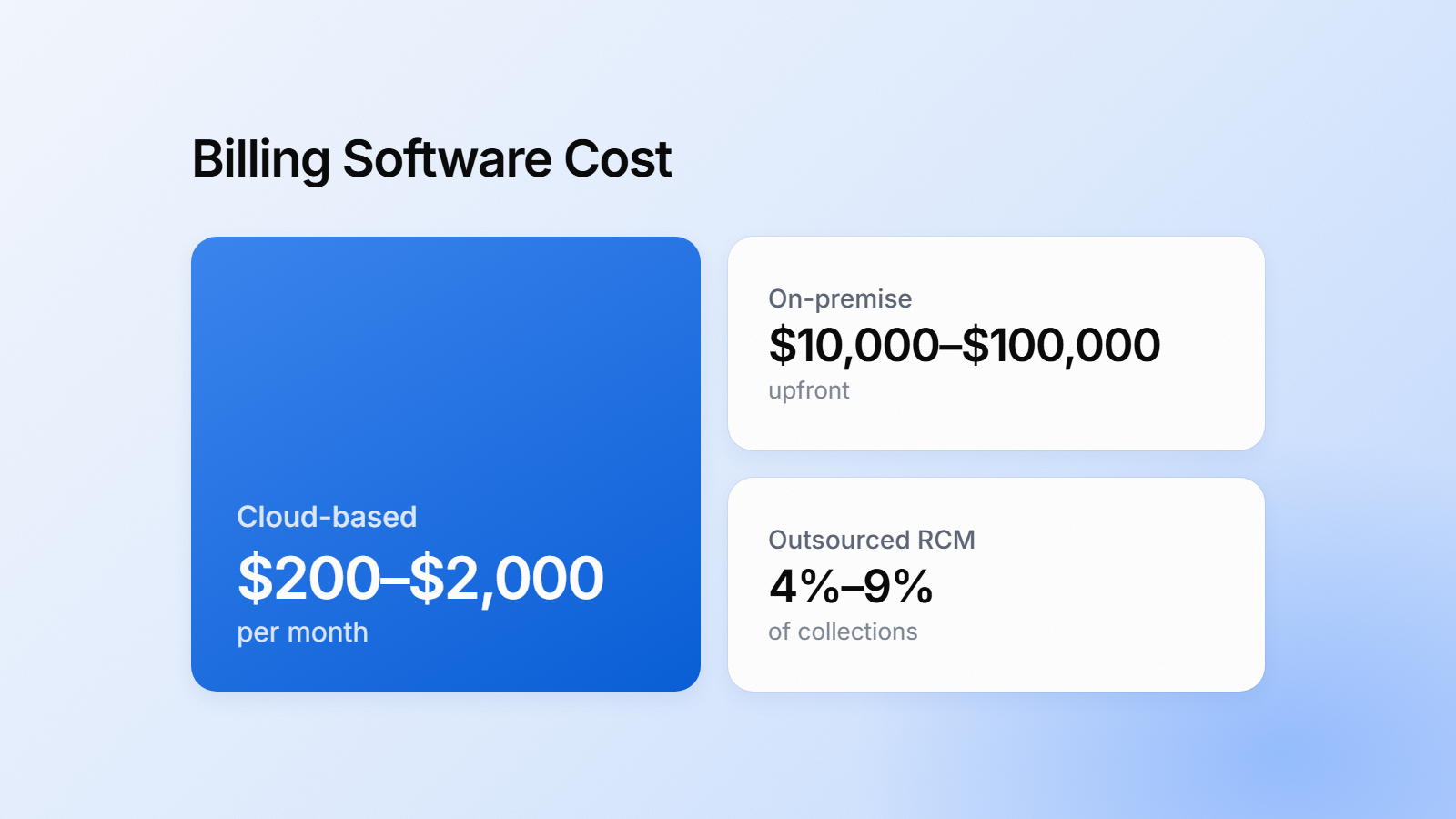
Monthly cloud-based medical billing software subscription fees are between $200 and $2,000, depending on whether the platform offers basic billing tools or a full electronic health record (EHR) and billing suite. On-premise systems require a one-time investment of $10,000-$100,000.
Practices that outsource billing completely, rather than licensing software, pay differently. Practices that use a revenue cycle management (RCM) model generally pay 4 to 9 percent of monthly collections. That model shifts cost risk: you pay more when collections are strong and less when they are weak, but the dollar total can exceed a flat subscription once your practice scales past a few providers.
Cloud versus Hybrid versus On-Premises
Hybrid medical billing software typically costs $150-$600+/provider/month, but costs will vary depending on deployment complexity, customisation, and cloud services used. On-premise is rare for small practices now, mostly appearing in hospital systems with existing IT infrastructure and compliance teams.
| Deployment Model | Typical Cost | Best For |
|---|---|---|
| Cloud-based subscription | $200 to $2,000/month | Most small to mid-size practices |
| Hybrid / per-provider | $150 to $600+/provider/month | Growing group practices |
| On-premise license | $10,000 to $100,000 upfront | Large health systems with in-house IT |
| Outsourced RCM (% of collections) | 4% to 9% of monthly collections | Practices that want billing fully handled |
Source: Software Finder research aggregating industry pricing benchmarks, 2026.
Medical Billing Software Pricing by Vendor in 2026
Published, vendor-verified pricing is less common in this space. The vast majority of companies (including the three below) quote custom pricing based on speciality, provider count and modules. These figures come from third party pricing aggregators and vendor sites, not confirmed list prices, so consider this more of a planning range than a quote.
athenahealth
athenahealth does not offer a flat per-provider plan for its athenaCollector billing module. Third-party aggregators typically quote the fee for collections-based billing services to be roughly between 4% and 8% of monthly net collections, with the actual percentage negotiated based on practice size, speciality, and services selected. Floor payment (minimum) per provider per month of approximately $140/provider/month (regardless of collections volume) Implementation costs generally run $2,000 – $5,000 per provider
User-reported rates indicate that a practice with $1.2 million in collections per year might expect to pay $60,000 to $84,000 per year under a 5 to 7% collections model. Flat per-provider pricing is almost always cheaper over $300,000 in annual collections per provider, even after you add separate billing services. Compare athenahealth directly to flat-fee vendors on the athenahealth profile page.
Advanced MD
AdvancedMD costs per provider per month, with any mid-level clinician or higher considered a provider, and medical speciality plans starting at $429 for practice management with billing and $729 for EHR and practice management. The full bundle with patient engagement starts at $999/month.
Speciality prices can vary greatly. AdvancedMD mental health plans range from $130 to $399 per provider. Today it costs $130 to get in. Physical medicine costs $399 per provider. Practices that want AdvancedMD to do billing, not just the software, pay the company 4% to 8% of monthly collections for the revenue cycle management services. View active packages on AdvancedMD profile.
CureMD
CureMD Pricing 2026 CureMD pricing varies based on the plan, number of providers, and services included. The software cost per provider per month is $195 for practice management alone, $295 for EHR, and $395 for the all-in-one EHR plus PM package. Billing Services are charged separately. Billing can be bundled with the EHR at 3% of collections, versus the industry standard of 4-8%.
A practice that collects $500,000 a year pays about $25,000 in CureMD billing fees under the percentage model, much less than the average annual cost of $54,000 for in-house billing, according to the same source. See CureMD’s current plans on its vendor profile.
| Vendor | Starting Price | Pricing Model |
|---|---|---|
| athenahealth | ~$140/provider/month minimum or 4 to 8% of collections | Percentage-of-collections, custom quote |
| AdvancedMD | $429 to $729/provider/month | Per-provider, modular bundles |
| CureMD | $195 to $395/provider/month | Per-provider tiers, or 3% of collections for billing services |
Source: vendor and third-party pricing aggregators, 2026.
Cost of Billing Software for a Small Practice
The question asked more than any other by solo and small group practices and the answer varies from the enterprise figures above. Small practice medical billing software typically runs $150 to $500 per provider per month in a software-only model. Full-service RCM outsourcing, where the vendor bills for you and takes a percentage of collections, usually ranges between 4% and 8% of collected revenue.
The complaint on the forums where solo providers share stories isn’t the sticker price. It is the difference between the advertized starting price and the final quote after adding in claim scrubbing, clearinghouse fees, patient statements and eligibility checks. Don’t sign until you get a full itemised quote from each vendor, not just the per-provider number.
Pricing for Speciality and Behavioural Health
Mental health and behavioural practices typically have lower volumes of billing and lower complexity of claims, and they pay less. SimplePractice is a popular option for solo therapists and small group practices and costs between $29 and $99 per month. General medical billing platforms built for primary care or multi-specialty groups are usually not a good fit for behavioural health workflows, so specialty-specific tools are typically the cheaper and better option here.
Hidden Costs Buyers Often Overlook
Hidden costs like setup fees, training, data migration and integration can tack on another $2,000 to $10,000 or more to your total investment. Vendors rarely list them upfront, they are on the first invoice instead of on the sales call.
The most common surprises are clearinghouse fees, e-prescribing add-ons, extra user seats over the included allotment, and annual maintenance on on-premise systems. Typical on-premises solutions incur annual maintenance costs of 15-20 percent of the original purchase price in addition to the original license. Be sure to factor these into your total cost of ownership comparison, and not just the headline monthly rate, before you shortlist vendors on the revenue cycle management hub.
Frequently Asked Questions FAQs
What is the monthly cost of medical billing software?
Most cloud-based medical billing software costs between $200 and $2,000 per month, depending on the size of your practice and the features included. Pricing per provider tends to range from $150-$600 or more per month. Vendors that bundle billing with a full EHR and practice management suite tend to be on the higher end of that range, while stand alone billing-only tools cost less.
Is RCM Software the Same as Medical Billing Software?
Medical billing software can manage claim creation, submission and payment posting. Complete revenue cycle management (RCM) software or services will further include eligibility checks, denial management, patient collections and reporting for the entire revenue lifecycle. Many vendors sell both as separate tiers. RCM services are often priced as a percentage of collections rather than flat subscription fees.
What is the most affordable medical billing software for a solo practice?
For basic plans, solo providers can often find billing tools for as little as $30 to $100 per month, and mid-range software-only options typically cost between $150 and $500 per provider per month. Platforms built specifically for therapists or small behavioural health practices can cost even less, as they have fewer enterprise-level billing modules.
What are the setup fees from medical billing software vendors?
And many do. On top of the monthly subscription, implementation, data migration, training and clearinghouse setup can add anywhere from a few hundred dollars to several thousand dollars, depending on the vendor and how much configuration your practice needs. Before signing, always ask for an itemised quote that shows the subscription price and one-time setup costs.
Percentage-of-collections pricing isn’t necessarily cheaper than flat-fee billing software.
It’s a function of your income. Percentage of collections pricing is often in the 4%-8% of monthly collections range and favours lower revenue or newer practices. Flat per provider fees usually become less expensive after a practice is collecting over about $300,000 per provider per year. Try both models with your real collections before you make a decision.