When hospital-owned groups seek revenue cycle vendors in 2026, they always arrive at the same fork in the road: buy the software and continue billing in-house or hand the entire operation over to a managed services firm. Waystar and R1 RCM are on opposite sides of that fork.
Waystar vs R1 RCM is really a question of claims and denials technology platform vs full outsourced revenue cycle operation. Waystar is a software platform company first, formed in 2017 from the merger of Navicure and ZirMed and now publicly traded on NASDAQ under the ticker WAY. RCM’s primary service offering is end-to-end RCM services for health systems, hospitals and physician groups, via an operating partner or co-managed relationship. Waystar typically has lower upfront costs; R1 RCM takes on more labour and risk.
This guide offers a breakdown of pricing, scope, KLAS recognition and what type of organization each vendor actually fits.
R1 RCM vs Waystar: Key Differences in Scope
It’s all about who does the work, in this split between these two vendors. Waystar gives billing teams software to run claims, eligibility and denials themselves. R1 RCM provides the technology and the people.
Waystar Royco
Waystar’s cloud-based RCM platform includes financial clearance, patient eligibility, prior authorisation, claims management, denial management, patient billing and payments, and analytics. The platform connects to more than 5,000 payers, a clear indication of extensive reach in the clearinghouse and claims space. The acquisition of Iodine also added clinical documentation improvement capability, with AI-driven clinical documentation analysis and physician querying.
R1 RCM (Revenue Cycle Management)
R1 RCM’s model combines healthcare domain knowledge with technology and process execution to help healthcare providers’ revenue cycle operations, including patient registration, insurance and benefit verification, documentation and coding of medical treatment, bill preparation and collections. In an operating partner relationship, R1 provides the entire revenue cycle infrastructure including personnel, technology and workflow, while in a co-managed relationship the client retains its existing staff and R1 supplements them with management and proprietary technology.
R1 RCM vs Waystar Pricing 2026
Neither vendor publishes a price list, which is standard enterprise RCM practice. But public filings, vendor statements and industry research give a usable range on it.
Waystar generally prices per platform and per claim. Pricing is custom quoted and there is no published rate card but the market estimates pricing to be approximately $0.05 to $0.25 per claim, volume tiered, and module based licensing for denial management, CDI and analytics. Enterprise agreements are typically $200,000 to $1 million plus per year for health systems. Another industry comparison indicated Waystar’s custom enterprise pricing at $50,000 to $300,000-plus annually depending on volume and modules.
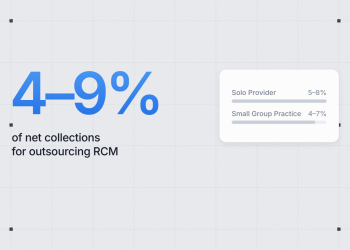
R1 RCM’s pricing model is different because it is a services contract and not a software license. Pricing for R1 RCM is tailored to net patient revenue and scope of services. Prospective customers need to contact the vendor for pricing. This is generally a percentage of collections, plus staffing costs built into the contract, rather than a flat annual software fee.
| Category | Waystar | R1 RCM |
|---|---|---|
| Pricing model | Per-claim plus module licensing | Percentage of net patient revenue, custom scope |
| Typical annual cost | $50,000 to $300,000+ (enterprise) | Custom, contract-based |
| Delivery model | SaaS platform, self-operated | Technology plus managed staff |
| Contract length | Varies by module | Often 5+ years, involves rebadging |
Source: Software Finder analysis of vendor and industry pricing data, 2026.
Waystar vs R1 RCM Features Side by Side
When buyers research r1 rcm vs waystar features, they usually want to know which one actually reduces denials and speeds up cash. Both have strength here, but the mechanism is different.
Claims & Reimbursement Admin
Waystar’s denial management solution automates the denials categorisation, root cause analysis, and appeal workflow routing to identify denial patterns across payers and CPT codes to feed into upstream billing edits. Denial prevention is part of the overall managed service at R1 RCM and not a separate module that clients configure themselves.
Financial Patient Engagement
As patient responsibility grows as a share of total accounts receivable, Waystar’s digital billing, payment plans, financial assistance screening and point-of-service collection are key. R1 RCM has patient financial engagement embedded into its end-to-end operating model, and doesn’t offer it as a standalone tool.
Epic & EHR Integration
With integration via HL7 interfaces and FHIR APIs, Waystar offers Epic-certified integration through App Orchard, emphasising denial management, prior authorisation automation, and patient financial engagement; R1 RCM is positioned for full outsourcing with end-to-end service, contrasting with a lighter integration footprint.
Which One Gets KLAS Honours
KLAS rankings divide ambulatory RCM services from end-to-end hospital outsourcing, and R1 RCM is strong in one but not a dominant player in the other. R1 has been named Best in KLAS for Ambulatory RCM Services (EHR-Agnostic) for five consecutive years. The picture is different for end-to-end outsourcing of general hospitals. Ensemble was awarded the 2025 Best in KLAS award for end-to-end RCM outsourcing, with an overall performance score of 95.1 points out of 100, the highest score. This would indicate that R1 RCM’s KLAS strength is in physician group services, and not necessarily hospital-wide outsourcing.
Waystar does not compete in KLAS end-to-end outsourcing category as Waystar is not a staffing or outsourcing company. Buyers should look at KLAS data and compare Waystar to others in the claims and clearinghouse software categories, not to full service RCM outsourcers.
Which Best Suits Your Organization
Waystar is more likely to be a good fit for multi-location practices and ambulatory groups that want to keep billing staff in house but need more robust claims automation. R1 RCM is where hospitals with shortages of billing staff, or those looking to exit the operational business entirely, tend to go.
If you’re looking for a single platform that bundles EHR, practice management and billing and you want to take a look, athenahealth is a third option. Not a direct replacement for either vendor here, but you see it pop up often on the same shortlist for mid-size groups considering build vs buy vs outsource.
FAQs
What is the difference between R1 RCM and Waystar?
Waystar is a software platform that organisations license and run with their own billing staff for their claims, eligibility, denials and patient payments. R1 RCM is a managed services provider that takes over revenue cycle operations, often stationing its own staff in a hospital’s business office in an operating partner or co-managed model.
Does R1 RCM do the billing themselves or do they farm it out?
R1 RCM provides revenue cycle operations on an outsourced basis. With an operating partner model, R1 supplies the people, technology and workflows; with a co-managed model, the client maintains its own staff and R1 adds management and technology.
Is Waystar or R1 RCM cheaper for a mid-size practice?
Waystar is typically the cheaper option for a mid-size practice as it charges platform and per-claim fees instead of taking a percentage of collections or covering full staffing costs. R1 RCM’s pricing is based on net patient revenue and scope of services, which is more suited to larger health systems than smaller practices.
For a hospital-based group, which is better, Waystar or R1 RCM?
That depends on whether the group wants to keep the billing staff in-house or outsource the operations. The groups that are affiliated with hospitals and want to handle billing workflows and automate claims and denials tend to select Waystar, whereas groups experiencing staffing shortages tend to select R1 RCM’s end-to-end outsourcing.
Is athenahealth a competitor of Waystar and R1 RCM?
athenahealth is a cloud-based platform that bundles EHR, practice management and RCM tools, so it competes more directly with Waystar than the full outsourcing provider, R1 RCM. Practices comparing all three should think about whether they want a combined EHR and billing system or a standalone RCM layer.