For a small practice billing $1.2 million a year, the losses from denied claims and staff turnover can be much greater than it would ever pay an outsourced RCM vendor. That’s the math many owners forget when they simplify the decision to only cheaper versus more expensive.
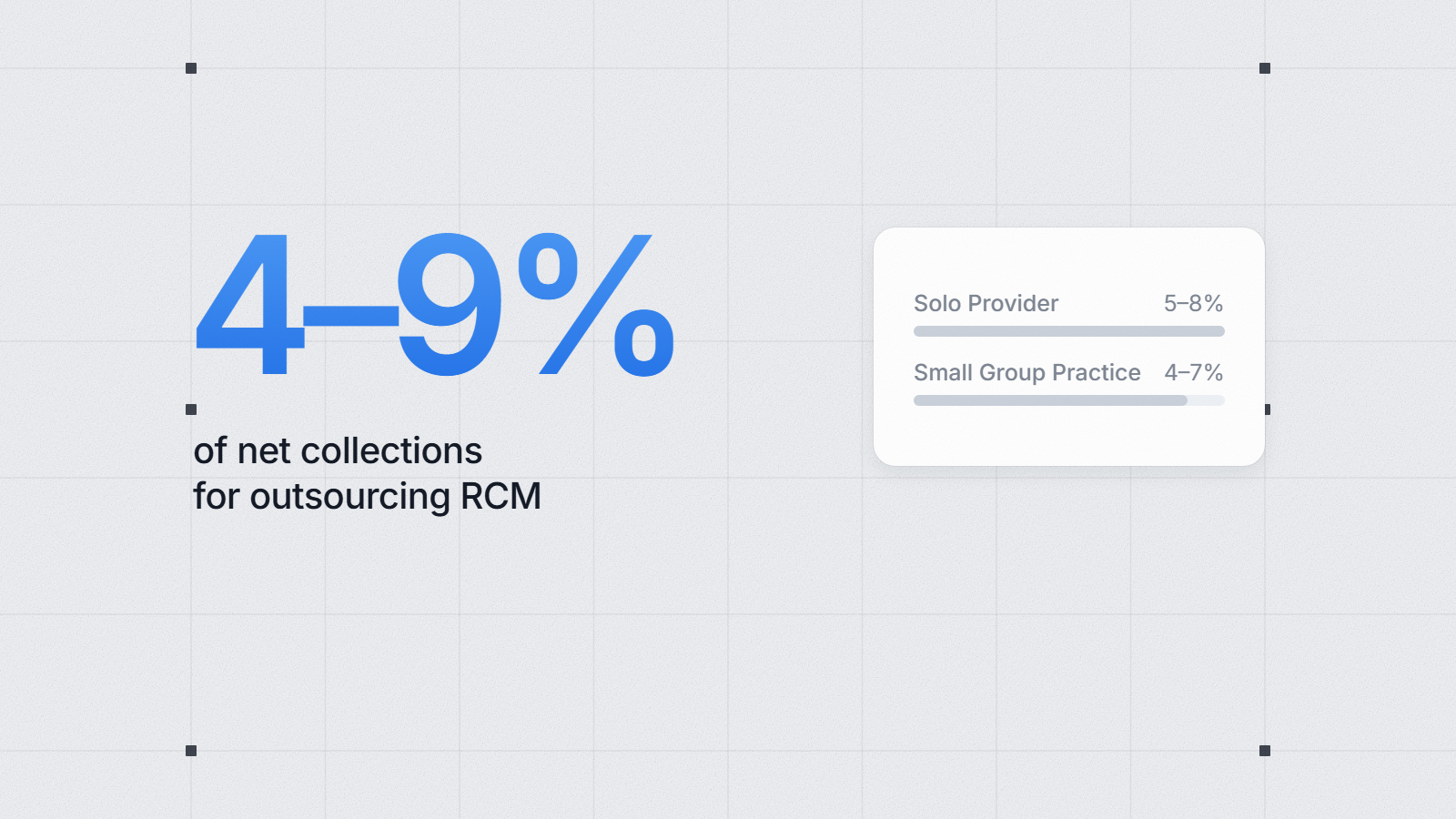
For most small practices in 2026, outsourcing RCM makes sense because the cost of outsourced billing is typically 4% to 9% of net collections, whereas a fully loaded in-house biller costs $90,000 to $140,000 a year. When you figure in denial rates and employee turnover, most practices with around $3 million in annual collections are better off financially outsourcing.
The same concerns are echoed by practice managers and doctors in Reddit threads: loss of control of the discussion about patient billing, being tied to a contract that is difficult to break, and whether the percentage fee is worth it vs simply hiring someone. “Those are good questions. They can also be answered with real numbers.
This guide breaks down the true cost of outsourcing vs. in-house staffing, where the math changes, and what questions to ask vendors like Waystar, R1 RCM, athenahealth, and AdvancedMD before you sign.
What the Numbers Really Tell You About Outsourced RCM vs. In-House Billing
Outsourced medical billing costs 4 to 9% of net collections, typically ranging from $1,500 to $5,000 per month for small practices. In-house billing costs $90,000 to $140,000 per biller per year when you factor in salary, benefits, software, training, and overhead. The crux of the decision is that gap.
The direct costs are compounded by the fact that in-house billing teams typically have denial rates of 12% to 18%, compared to 2% to 8% for specialised outsourced firms. A high denial rate is more than a nuisance. It reduces the percentage of your billed revenue that ever becomes cash.
For a 3-provider practice, in-house billing typically costs $83,000 to $111,000 or more annually for 1 to 2 fully loaded FTEs, compared to $42,000 to $75,000 for outsourced billing at 5% to 8% of collections of $750,000 to $1 million. In theory, the offloaded figure is frequently lower, even before you consider the better collection rates.
The average mid-size billing department of 8 to 12 FTEs making $42K to $65K plus 25% benefits can cost $400K to $975K per year. The total cost of a 10-person in-house RCM team can range from $500K to $1.2 million annually. Conversely, the average outsourced RCM cost for a mid-size practice is between $100,000 and $300,000 per year and typically includes billing, collections, denial management, and basic reporting.
Where the Break-Even Point Is
For most practices the breakeven point is below $3 million in collections and outsourcing generally costs less than a well-staffed internal team before even factoring in the difference in denial rates and days in accounts receivable. Below that level, the fixed cost of running a full billing department rarely makes good sense compared with a variable percentage fee.
The economics usually favour outsourcing at about $120,000 to $150,000 in monthly gross charges and below $80,000 a single, experienced in-house biller is often cost competitive. That’s a good gut check for solo and two-provider practices trying to figure out which side of the line they fall on.
How Much Do RCM Outsourcing Companies Charge in 2026
Pricing is not one number. It moves with specialty, volume, and how much of the revenue cycle you hand off.
| Practice Type | Typical Fee Range |
|---|---|
| Solo Provider | 5% to 8% |
| Small Group Practice | 4% to 7% |
| Multi-Specialty Practice | 3% to 6% |
| Large Healthcare Groups | 2% to 5% |
Source: Right Medical Billing, 2026.
This model aligns the billing company with the provider’s financial success because most vendors only get paid when claims actually collect. Most billing companies will charge 4% to 10% of net collections. The sweet spot for most small to mid-sized practices is in the 5% to 8% range. Solo practices and startups pay on the high end and large groups with a strong claim volume can negotiate down to 4% to 5%.
Speciality is also important. For high-volume, lower-complexity specialities like family medicine or paediatrics, a 3% to 6% rate is common, whereas a 7% to 9% rate shows up for complex, lower-volume specialities like cardiology or neurosurgery where claims require deep expertise and aggressive follow-up.
Advantages and Disadvantages of Outsourcing RCM for Small Practices
No one model is a clear winner. “That choice depends on the size of your revenue, the complexity of your claim and your appetite for managing a vendor relationship.”
Advantages of Outsourcing RCM
- Billing costs can be a variable, not a fixed, expense. A percentage-based model is also flexible for smaller practices that cannot afford a full billing department. The in-house team is on payroll regardless of the number of claims being processed.
- Lower denial rates than many in-house teams, as noted above, which is a direct driver of net collections.
- One of the most obvious benefits to outsourcing over the in-house model, especially for growing or seasonal practices, is that when volume increases, the outsourced team takes on the workload, and when volume slows, you aren’t paying for idle staff.
Cons of Outsourcing RMC
- For high-revenue practices, that percentage can translate into a sizable dollar figure. A practice that collects $5 million a year at 6% is paying $300,000 in billing fees — more than the cost of a well-run in-house billing team.
- Less daily oversight of patient billing communication and decision-making at the claim level than an in-house team.
- Usually, vendor lock-in will be higher than doing it yourself, which is related to data migration and retraining if you change providers later.
What Small Practices Should Ask Before Entering Into an RCM Contract
Price alone doesn’t tell you if a vendor will perform. What are the benchmarks for net collection rate? Average days in accounts receivable? How is the denials process escalated?
1. Check the fee basis
Be sure the fee is based on net collections, not gross charges, as CMS guidelines require that structure for compliant billing arrangements.
Step 2. Request denial rate data
Ask the vendor what their average first-pass claim acceptance rate is, what their denial rate is by speciality, and compare it to your current in-house numbers.
Step 3: Review the BAA terms and data handling terms
Any RCM vendor handling patient data must have a signed Business Associate Agreement. Note that there is no such thing as HIPAA Certification, so beware of any vendor that claims to be HIPAA certified.
Step 4: Check contract exit clauses
Ask how claims data is transferred back to you, or to a new vendor if the relationship ends, and what the notice period looks like.
Frequently Asked Questions
Is Outsourced RCM More Affordable Than Hiring In-House Billing Staff?
Yes. Most practices under about $3 million in collections per year. A fully loaded in-house biller can cost $90,000 – $140,000 per year in salary, benefits, software, and turnover. Outsourced RCM typically costs 4%-9% of net collections. Beyond that revenue level, a well-run in-house team can sometimes cost less per dollar collected.
What is the normal RCM outsourcing cost?
The majority of companies offering RCM outsourcing services will charge between 4% and 10% of net collections. For small to mid-sized practices, the normal range is 5% to 8%. Solo shops and low volume specialities tend to be on the high end while big groups with strong claim volume can negotiate down towards 4% to 5%.
What are the drawbacks of outsourcing medical billing?
Biggest risks are loss of direct control of claims and patient billing communication, vendor lock-in on data migration, hidden fees buried in contracts, and exposure to compliance if the vendor mishandles protected health information. Before signing, practices should check for signed BAAs, ask about denial rates, and review contract termination provisions.
What does it cost to keep medical billing in-house?
A fully loaded in-house biller costs about $90, 000 to $140,000 per year when you factor in salary, benefits, software, training and overhead. Turnover costs an additional $9,000 to $12,600 per replacement and in-house teams often have denial rates of 12% to 18% versus 2% to 8% for specialised outsourced firms.
When does RCM outsourcing not make sense from a revenue standpoint?
When a practice approaches $3 million in collections a year, the cost advantage of outsourcing often disappears, because the percentage fee on that amount can exceed the cost of a well-run in-house team. Below that line outsourcing is typically cheaper and lowers staffing risk for smaller practices.
RCM Partner Versus In-House Billing: What to Consider in 2026
If your practice collects less than $3M annually and you currently have issues with denials or turnover in your team, then based on the cost data above, outsourcing is something to seriously consider. If you’re nearer that mark, and have a stable, well-trained billing staff, run your own numbers before making the change.
Get in-depth profiles of Waystar, R1 RCM, athenahealth, AdvancedMD and more. Check out the Revenue Cycle Management hub on Software Finder to get vendor quotes, compare scope of service and read client reviews.