A 25-bed critical access hospital in Nebraska doesn’t need the same system as a 900-bed academic medical center, but many small hospital boards still start their search by asking for Epic demos. That mismatch takes months. The best hospital information system for small hospitals in 2026 is one that is sized and priced for facilities with less than 150 beds with support staff that understands rural reimbursement and limited IT headcount.
This guide ranks seven systems that fit small and rural hospitals specifically—not enterprise health systems. Each entry has verified pricing ranges and KLAS or Black Book standing if available, and who the system is really for.
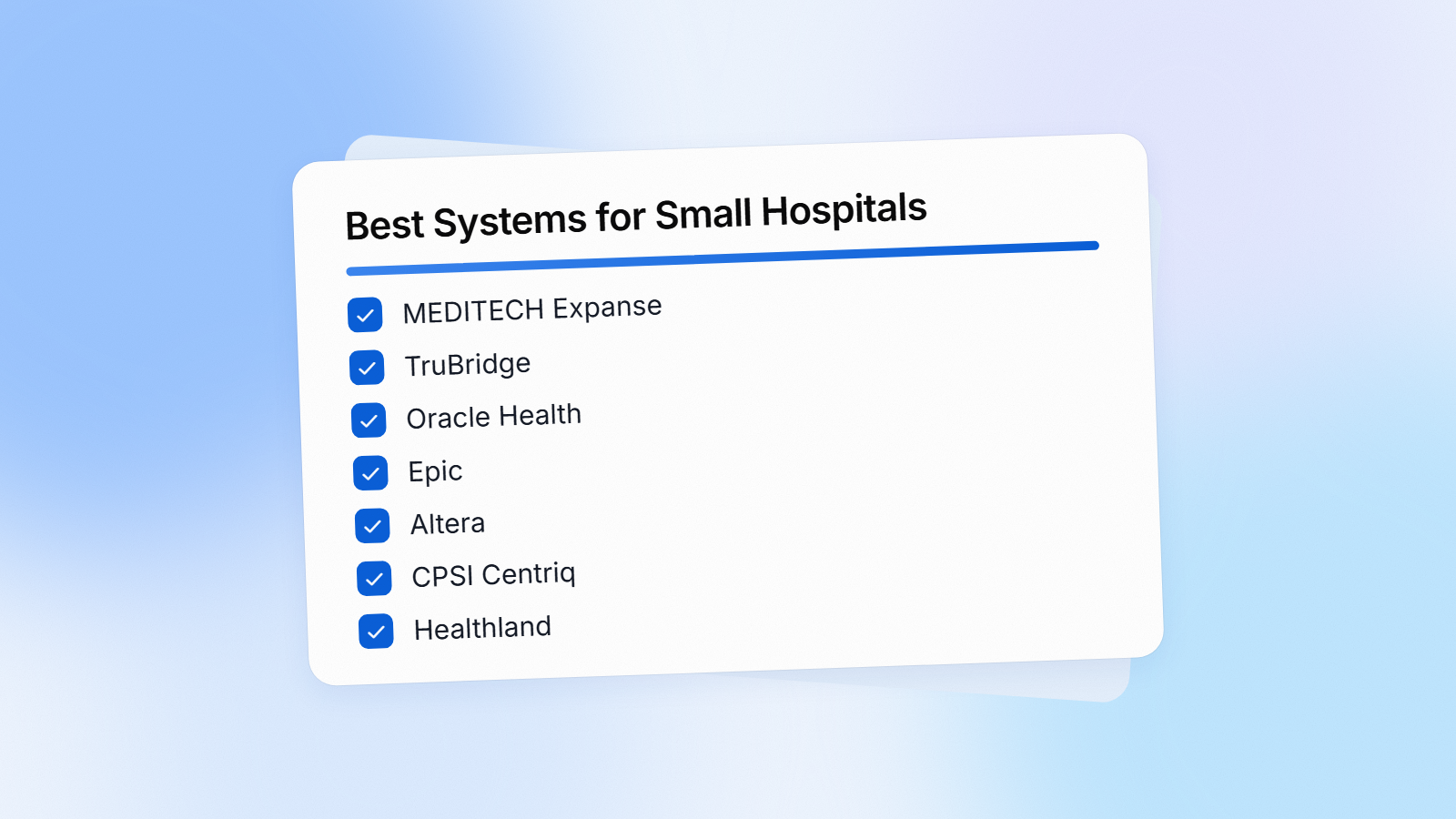
MEDITECH Expanse is the #1 ranked EHR in the combined Acute Care EHR & Patient Accounting (Small 1-150 Bed) segment for the second year in a row, leading the small hospital category for the second year running and marking the 7th year in a row that MEDITECH Expanse has led the Small Acute Care EHR segment. TruBridge, Oracle Health community edition, and smaller niche vendors round out viable options based on budget and whether revenue cycle outsourcing is needed.
What is the Right Hospital Information System for a Small Hospital?
KLAS research shows small hospitals – defined as having between 1 and 150 beds – need different resources than large systems. They are smaller, operate with tighter margins, and are often critical access facilities that are reimbursed by the federal government based on their size. A system designed for a 500-bed hospital costs licensing and implementation that a 40-bed hospital can’t absorb.
Small hospitals surveyed consistently reported unsustainable costs, poor vendor support and severe cybersecurity vulnerabilities with legacy systems, with declining Medicaid reimbursement rates cited as additional barriers limiting cybersecurity investment. That’s why bed-count-specific KLAS segments and vendor experience with rural facilities are more important than brand name recognition.
7 Best Hospital Information Systems for Small Hospitals [2023]
1. Expanse, MEDITECH
MEDITECH Expanse is the most decorated system in this category. MEDITECH #1 in the newly combined Acute Care EHR & Patient Accounting (Small 1-150 Bed) segment 6th year in a row MEDITECH Expanse has been the leading solution in the Small Acute Care EHR segment as reported in the 2025 KLAS report, extending into the 2026 report for a 7th year in a row. One hospital CEO, surveyed by KLAS, said one of the biggest strengths of MaaS is the cost compared to the alternatives and the ability to work with the vendor directly rather than through a larger health system. Expanse is available on-premises, private cloud hosting and subscription (MEDITECH as a Service).
2. TruBridge (previously CPSI/Evident)
TruBridge is built for this very segment. TruBridge is a provider of healthcare technology and services that supports revenue cycle management, EHR, coding and other support for rural, critical access, community and ambulatory providers. TruBridge is a long-standing leader in electronic health records and healthcare IT solutions for rural and community hospitals with a large installed base of over 1,500 facilities throughout the United States. TruBridge Evident CPSI was named the top vendor for full RCM capabilities in the 2026 Black Book survey of small hospitals, which is key for hospitals looking for billing and EHR bundled together.
3. Oracle Health (formerly Cerner) Community Editions
The company has smaller-scope editions for smaller facilities, apart from its enterprise suite used by large academic medical centers. Small hospitals considering Oracle Health should confirm the tier of the product being quoted as Oracle’s enterprise modules have different implementation requirements than those serving the community.
4. Epic Community Connection
Epic is generally not the right choice for stand-alone small hospitals, but its Community Connect program allows small facilities to use Epic’s EHR by partnering with a larger health system that already uses Epic. It gives smaller hospitals Epic’s interoperability without having to outright purchase a full enterprise license, though it locks the hospital into the contract terms of a sponsoring health system.
5. Altera Digital Health
In the 2026 Black Book survey, respondents from small hospitals ranked Altera as a close second to TruBridge for revenue cycle integration, and Altera Digital Health as a close second to Altera. Hospitals with a focus on RCM with clinical documentation should request a demo.
6. CPSI Centriq (legacy, now TruBridge)
If you’re still using legacy Centriq or Evident Thrive at your hospital, note that these products are now under the TruBridge brand after the 2024 consolidation. Customers of CPSI that are considering an upgrade have essentially been looking at what TruBridge offers currently.
7. Healthland (legacy, folded into TruBridge)
Healthland was a stand-alone brand for small rural and critical access hospitals before it was consolidated under TruBridge’s parent company. Facilities with legacy Healthland systems should look at current TruBridge pricing and support structures when planning their next contract renewal, rather than considering Healthland as an independent option.
How Much Does a Small Hospital HIS Cost in 2026
Most vendors in this category quote pricing privately based on bed count and modules, so get at least two quotes before budgeting. Published benchmarks give a useful starting range.
| Cost Component | Typical Range |
|---|---|
| Cloud-hosted SaaS, per provider/month | $500 |
| On-premises license (one-time) | $60,000 |
| Annual maintenance | $12,000/year |
| Implementation (one-time) | $10,000 to $100,000+ |
| Training (one-time) | $1,000/user |
Source: Software Finder vendor pricing benchmarks, 2026.
Costs for a system in this category can range from $300 per user per month for smaller deployments to $25,000+ per month for larger healthcare organisations, so small hospitals should push vendors for quotes scoped specifically to their bed count versus generic enterprise rate cards. We are seeing RCM-heavy contracts like TruBridge’s bundled services priced as a percentage of net collections rather than flat subscription.
Frequently Asked Questions
What is the best hospital management system for small hospital?
MEDITECH Expanse is the #1 recommended small hospital solution, ranked #1 in KLAS’ Acute Care EHR & Patient Accounting segment for 1 to 150 beds for seven years running. TruBridge, designed specifically for rural and community hospitals, is an excellent choice for facilities that want bundled revenue cycle outsourcing with the EHR.
What is the price of a small hospital HIS?
Pricing is quote-based and varies depending on the number of beds, modules, and deployment model. Published benchmarks indicate small hospital EHR deployments hosted in the cloud at about $500 per provider per month and on-premises licenses at about $60,000 one-time plus annual maintenance of about $12,000. Typically implementation will add $10,000 to $100,000 depending on scope.
Can smaller hospitals afford Epic or Oracle Health?
Epic is usually priced and staffed for hospitals with 150+ beds and dedicated IT teams, which is a stretch for most small or critical access hospitals. Oracle Health has community and rural-friendly editions that are somewhat more accessible, but both vendors usually require bigger budgets and implementation teams than MEDITECH or TruBridge.
What’s the difference between a small hospital HIS and an enterprise system like Epic?
A small hospital HIS is scoped for 1 to 150 beds, with simplified modules, lower staffing needs and pricing on a per bed or per provider basis rather than enterprise-wide licensing. Epic and other enterprise systems are built for multi-site health systems with complex interoperability and dedicated IT departments. This adds cost and implementation time that most small hospitals cannot justify.
Do small HIS vendors for hospitals sign HIPAA business associate agreements?
Yes. There is no such thing as a HIPAA-certified software product. Reputable HIS vendors, such as MEDITECH, TruBridge, Oracle Health, and Epic, sign business associate agreements (BAAs) with hospitals as a matter of standard contracting. This is the right way to verify HIPAA compliance before you buy.